Customer Story
How Stadium Goods converted technical debt into global omnichannel capability | Avion Advisors
results
$230.9M
M&A
Consideration by Farfetch following completion of the Stadium Goods acquisition

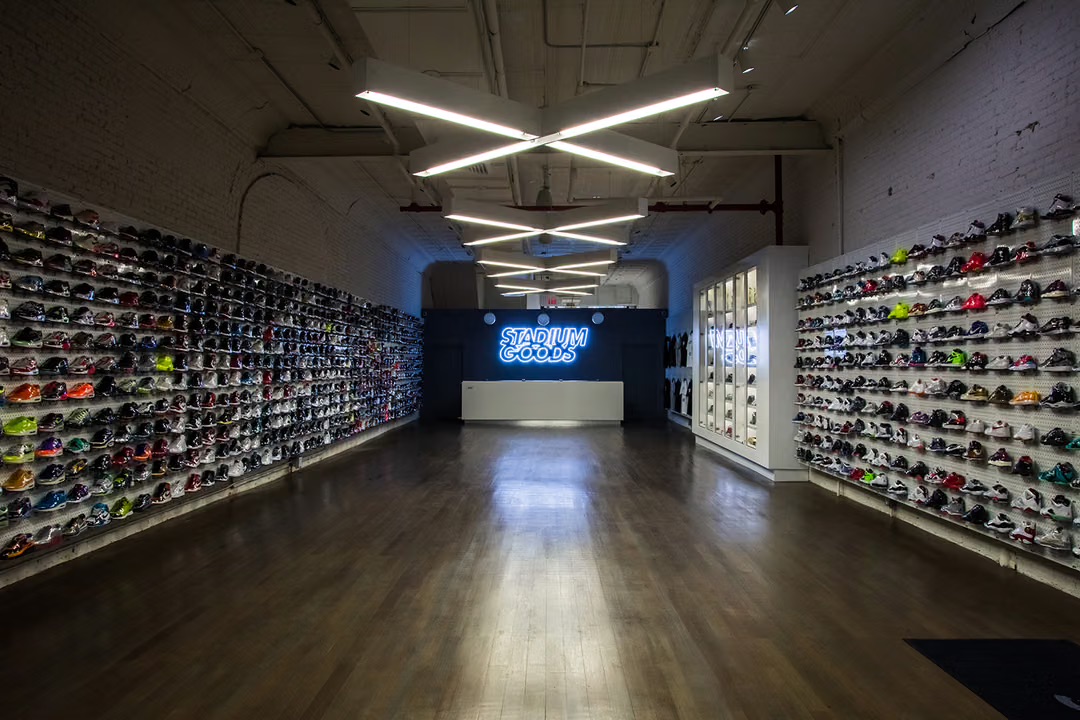
Stadium Goods had built strong demand and cultural relevance across premium sneakers and streetwear, but its early systems were not designed for the complexity of global omnichannel commerce.
Consignment, authentication, inventory, pricing, ecommerce, retail, logistics, customer support, and marketplace integrations needed to operate through one coherent system. MVP-era technical debt, fragmented workflows, and generic ecommerce tools were increasingly limiting the company’s ability to scale with control.
Avion approached the challenge as an operating-system redesign rather than a conventional replatforming exercise.
The central question became:
How can a fast-growing marketplace convert customer demand into a controlled, repeatable, and globally scalable operating system?
Avion mapped the end-to-end environment across seller intake, authentication, inventory, pricing, product data, ecommerce, retail, logistics, customer support, engineering, and organizational ownership.
That work informed a future-state architecture centered on proprietary reseller workflows, unified inventory and transaction data, clearer product and engineering priorities, agile delivery practices, omnichannel integrations, and a technology organization structured around the operating model itself.
"Scale becomes durable when the systems underneath growth become more coherent—not more fragmented—as complexity increases.”
The goal was not technology for its own sake. It was to create greater visibility, control, and adaptability across the business while reducing dependence on disconnected third-party tools.

Avion supported implementation by scaling the engineering organization, reducing technical debt, reorganizing teams, strengthening integration capability, and developing commerce connections across the United States, South America, and Asia.
The work connected several capabilities that had to mature together:
The existing engagement record reports that the engineering organization grew to 22 people within nine months and monthly GMV increased approximately fivefold, from about $5 million to approximately $25 million. Farfetch subsequently announced its agreement to acquire Stadium Goods for an enterprise value of $250 million in December 2018. These milestones provide evidence of the wider trajectory and should not be attributed solely to any one Avion workstream.
The durable capability was Stadium Goods’ ability to operate a proprietary omnichannel system connecting sellers, inventory, data, logistics, marketplaces, physical retail, and customers—and to continue evolving that system as the company entered its next stage.
For Avion, this is Regenerative Innovation in practice: each new transaction, marketplace connection, and operating cycle could now add intelligence, technical capability, and organizational knowledge back into the platform rather than simply adding complexity.
Sovereignty gained: Greater technological control, global channel optionality, data integrity, and investment readiness.
Capability regenerated: Marketplace intelligence, engineering capacity, operating knowledge, and partner connectivity.