
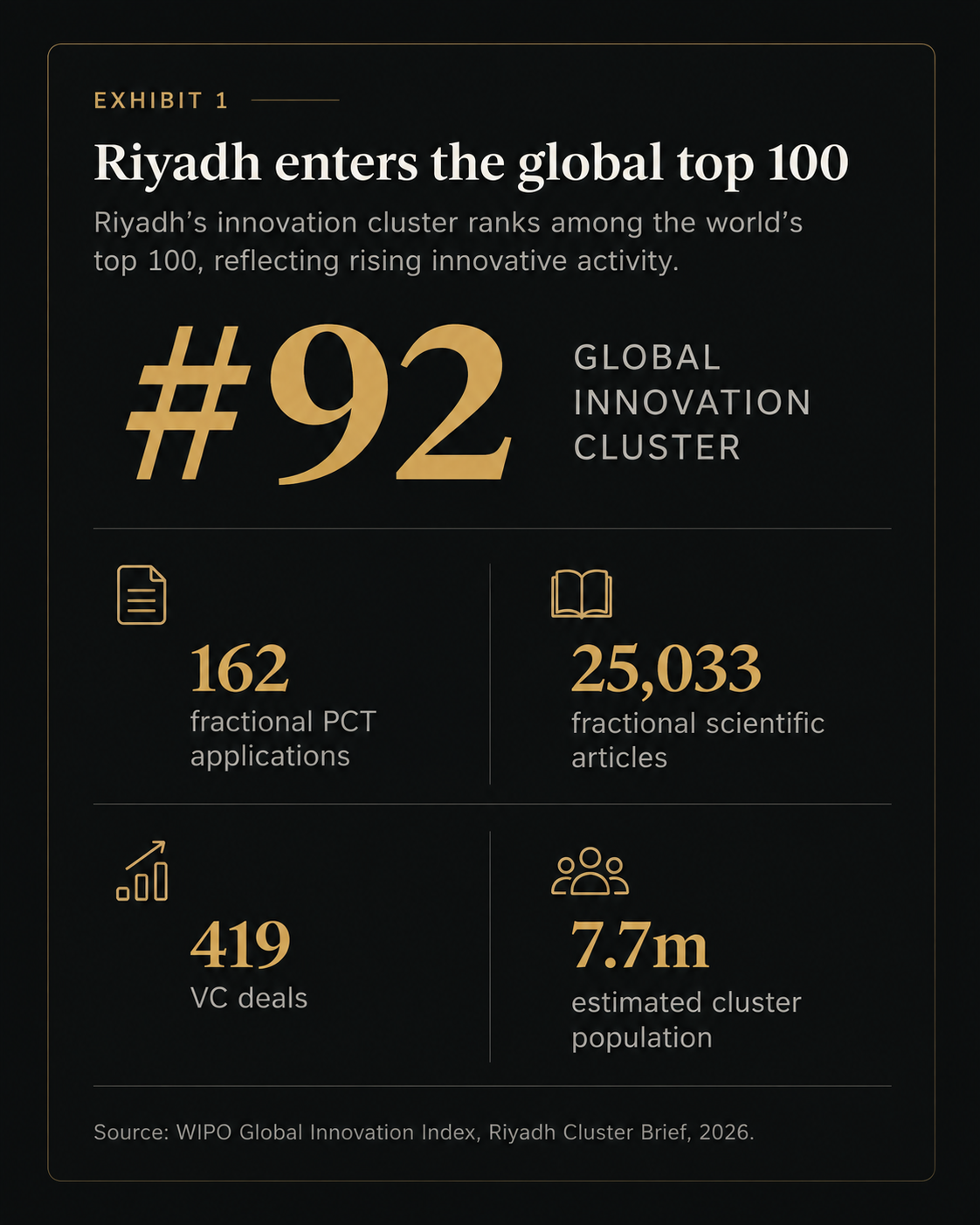
Riyadh’s entry into WIPO’s Global Innovation Index top 100 innovation clusters in 2026 is an important milestone for Saudi Arabia. At 92nd globally, Riyadh is the Kingdom’s first city to enter the ranking, which identifies geographic concentrations of patenting, scientific activity and venture-capital formation. Over WIPO’s most recent five-year measurement period, the cluster recorded 162 fractional PCT applications, 25,033 fractional scientific publications and 419 venture-capital deals.
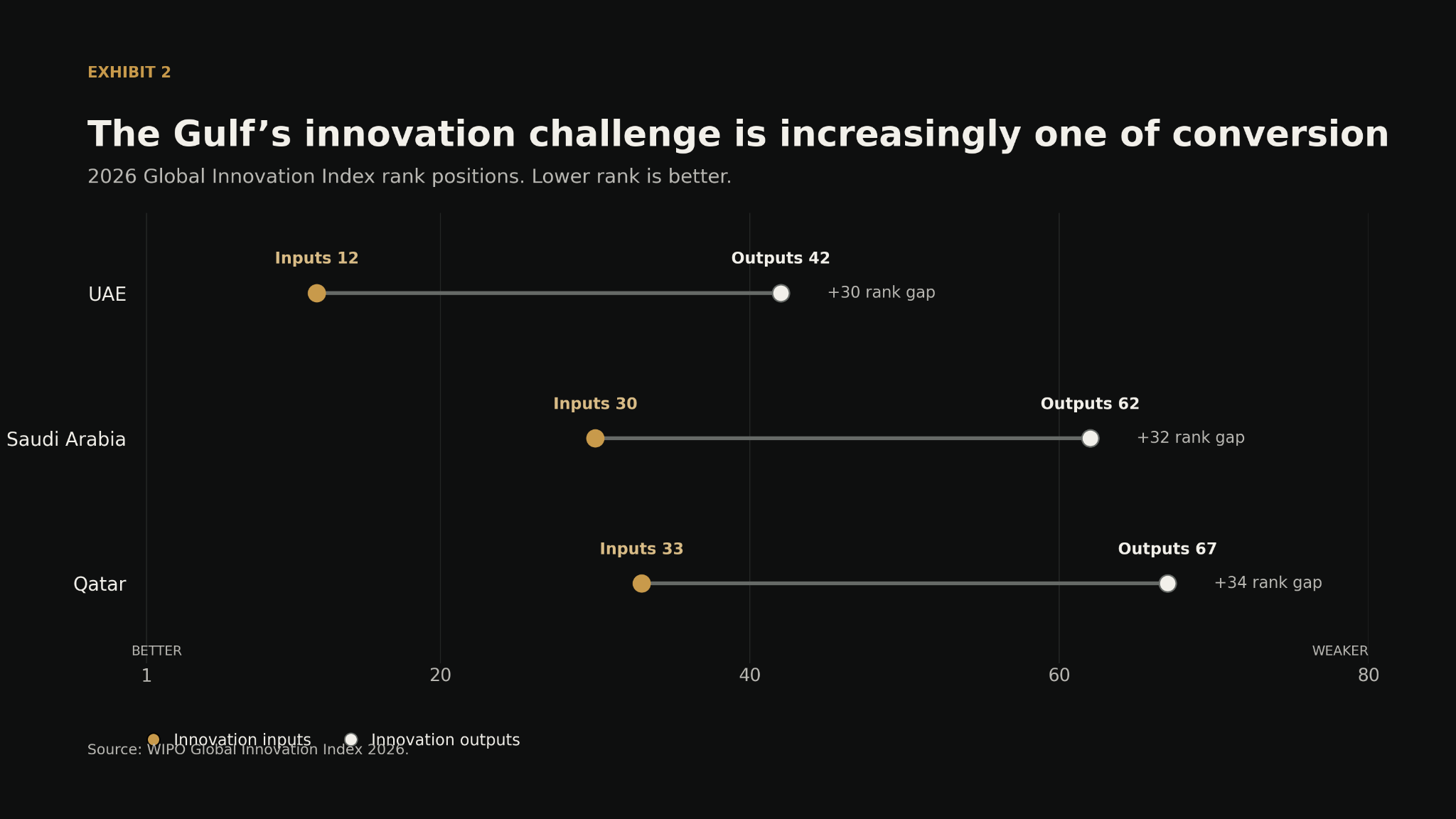
The significance extends beyond the ranking itself. Saudi Arabia has spent much of the past decade building the enabling architecture of an innovation economy: digital infrastructure, research institutions, sovereign capital, intellectual-property frameworks, industrial platforms and a more developed entrepreneurial environment. In the 2026 GII, the Kingdom ranks 42nd overall and 30th for innovation inputs, while its innovation outputs rank 62nd. WIPO identifies this input-to-output conversion challenge across several Gulf economies.
For Saudi Arabia, this creates a different strategic question for the next phase of Vision 2030. The principal constraint is becoming less about whether the Kingdom can assemble innovation capacity, and more about whether that capacity can generate commercially viable capabilities, companies and intellectual property that subsequently reproduce themselves.
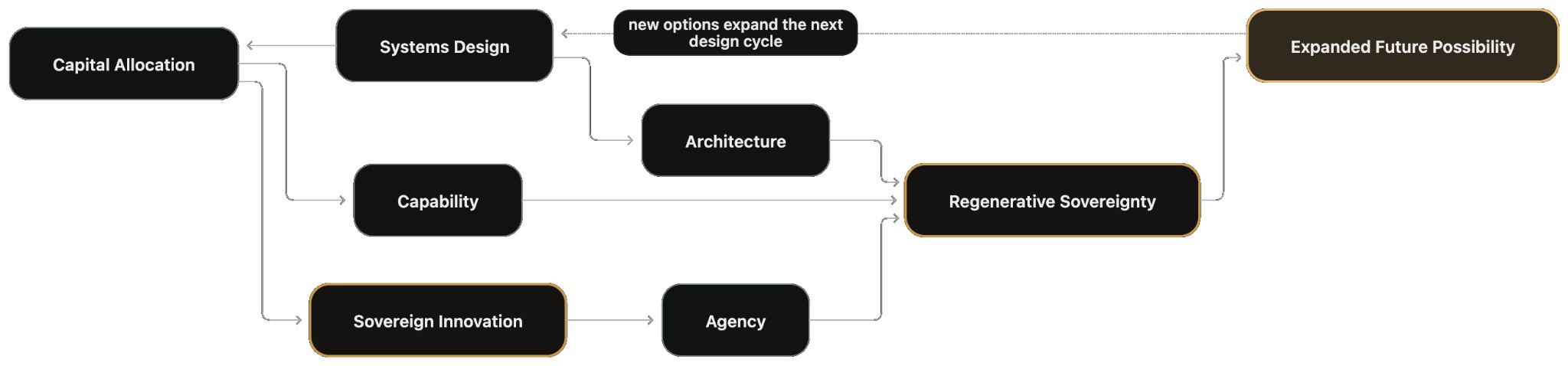
This is the distinction at the center of Avion’s Sovereign Innovation thesis. Capital can finance infrastructure and institutions. Sovereignty emerges when those assets create durable architecture, capability and agency. Regenerative sovereignty is achieved when each cycle generates the knowledge, firms, capital, talent and optionality required for the next.
Riyadh’s emergence suggests that this transition is beginning.
The next stage is more demanding: moving from ecosystem construction to ecosystem compounding.
Innovation rankings are often interpreted as scorecards. Cluster rankings are more useful when interpreted as evidence of economic concentration.
WIPO’s cluster methodology brings together three forms of activity: international patent applications under the Patent Cooperation Treaty, scientific publications and venture-capital deals. A city therefore does not enter the ranking because it has adopted an innovation strategy or attracted large amounts of capital. It enters when inventors, researchers and entrepreneurial financing become sufficiently concentrated within the same geography to become globally visible.
Riyadh now meets that threshold and its cluster has an estimated population of 7.7 million. SABIC leads local PCT activity, followed by Saudi Aramco and SABIC Agri-Nutrients; King Saud University accounts for 63 percent of Riyadh's fractional scientific publication count.
That composition is strategically important as Riyadh is emerging from a base that combines industrial R&D, university research and venture formation. This differs from innovation hubs built primarily around consumer software or financial technology. It creates a pathway more consistent with Saudi Arabia's comparative advantages in energy, industrial systems, materials, infrastructure and large-scale domestic demand.
The ranking should therefore be interpreted as an early indicator that previously separate components of the Saudi innovation system are beginning to occupy the same economic geography. The next question is whether they begin to reinforce one another.
Saudi Arabia's national innovation profile tells a complementary story.
The Kingdom ranks 42nd in the 2026 GII, but its innovation inputs rank 30th compared with 62nd for outputs. The same pattern is visible in the UAE and Qatar: strong institutional, infrastructure and investment foundations are not yet producing outputs at a comparable position in the global rankings. WIPO explicitly identifies conversion as the next challenge for these economies.
For policymakers, the distinction matters because the policy response to an input shortage is different from the response to a conversion problem.
An input shortage calls for more infrastructure, capital, research institutions or talent.
A conversion problem requires stronger interfaces between those assets.
Saudi Arabia already ranks first globally in ICT use, second in finance for startups and scaleups, fourth in government online services and fifth in entrepreneurship policies and culture. At the same time, public research–industry co-publications rank 105th and domestic industry diversification 90th.
Those figures suggest that the marginal opportunity increasingly lies not in adding another component to the ecosystem, but in improving the pathways between existing components:
research → intellectual property → company formation → procurement → scale → exports → reinvestment.
This is where innovation policy begins to become capability policy.
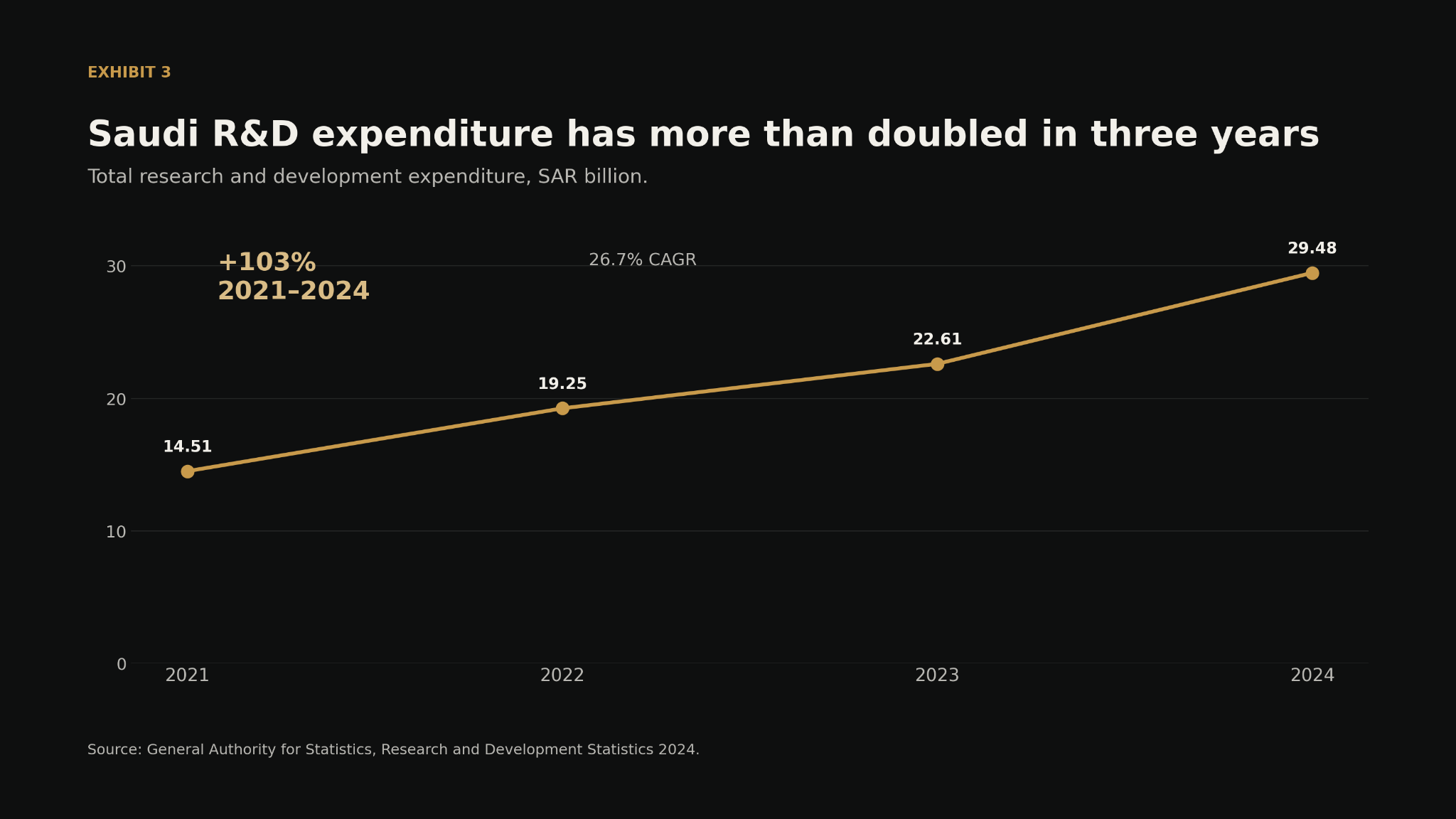
Saudi R&D expenditure increased from SAR14.51 billion in 2021 to SAR29.48 billion in 2024. The latest year represented a 30.4 percent increase over 2023. Business accounted for 40.3 percent of spending, government 40.2 percent and higher education 19.5 percent.
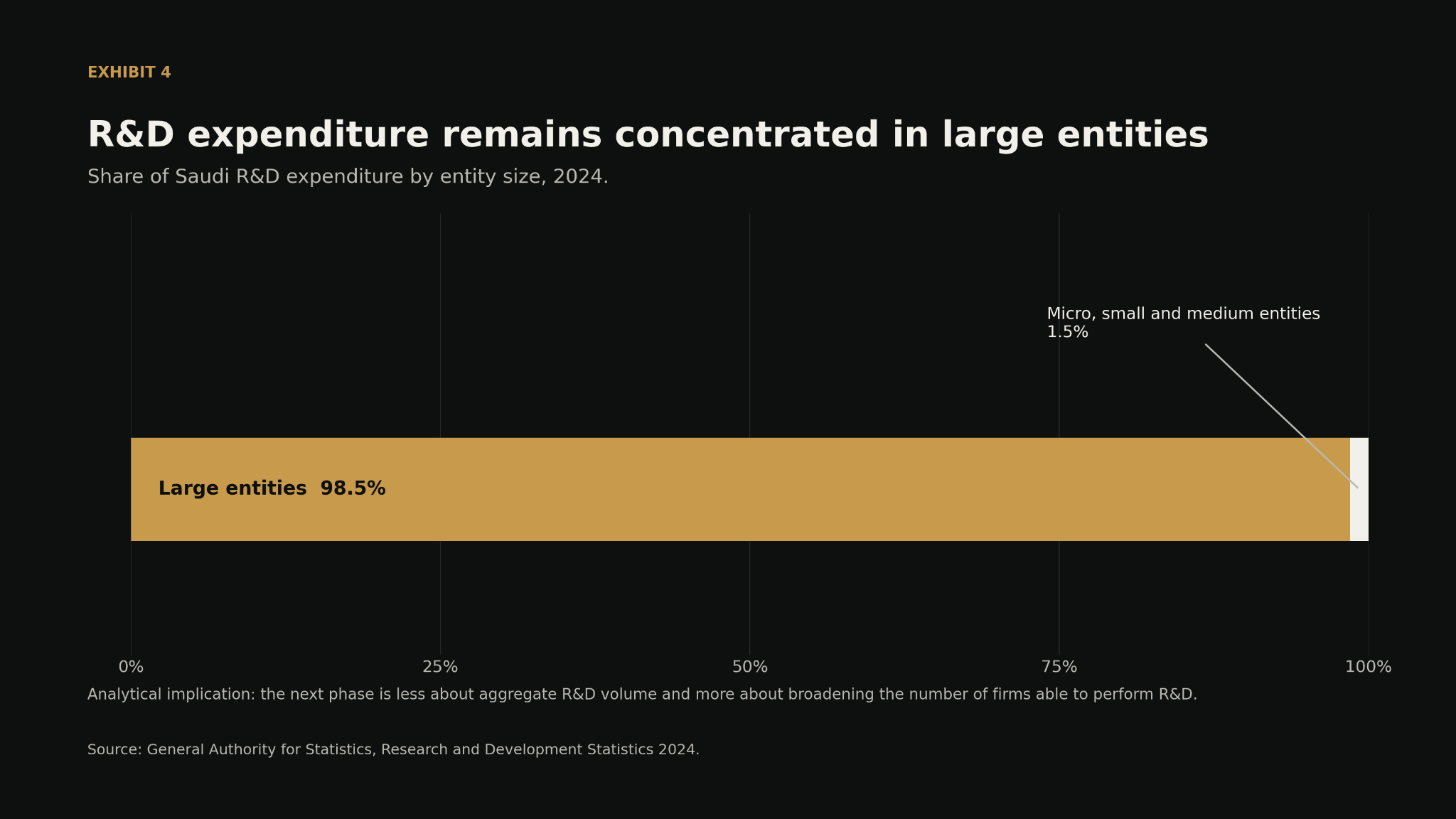
The distribution of that expenditure, however, highlights the next institutional challenge. Large entities accounted for 98.5 percent of Saudi R&D expenditure in 2024, while micro, small and medium-sized entities accounted for 1.5 percent. Large entities accounted for 98.5 percent of Saudi R&D expenditure in 2024, while micro, small and medium-sized entities represented only 1.5 percent. The concentration of research talent is similarly notable: higher education employed 71.3 percent of R&D workers, compared with 22 percent in business. Together, these figures suggest that the next challenge is not simply increasing aggregate research intensity, but broadening the organizational base through which R&D is conducted and commercialized.
This does not imply that large-entity R&D is undesirable. On the contrary, large industrial and research institutions are often essential anchors for advanced innovation systems.
The issue is one of organizational breadth.
Mature innovation economies typically contain a dense middle layer around their anchor institutions: specialist engineering businesses, university spinouts, research-intensive SMEs, technology suppliers, independent laboratories, scaleups and serial entrepreneurs.
These organizations perform an important economic function. They allow knowledge developed inside universities and national champions to migrate into new organizational forms.
Saudi Arabia's next phase therefore requires not simply more R&D, but a broader distribution of organizations capable of performing R&D themselves.
This distinction can be understood across three dimensions: capital density, capacity density and capability density.
Saudi Arabia has substantial capital density.
It is rapidly increasing capacity density through universities, laboratories, digital infrastructure, national programs and industrial platforms.
Capability density is more demanding. It describes the concentration of organizations and people that can repeatedly move from discovery to commercialization—and retain enough experience to perform the process better the next time.
In mature clusters, the cumulative effect matters more than the individual startup.
An engineer leaves a large company and becomes a founder. A university researcher licenses technology into that company. A customer becomes the first commercial deployment partner. Early employees leave after an exit and create three additional companies. An experienced founder begins investing. Suppliers acquire specialized knowledge. Capital returns to the ecosystem.
Individual companies may disappear; the accumulated capability can remain within the ecosystem.
That is the difference between financing innovation activity and accumulating innovation capability.

Several recent institutional developments indicate that the policy architecture is moving in this direction.
RDIA's four national RDI priorities—Health and Wellness; Sustainable Environment and Supply of Essential Needs; Energy and Industrial Leadership; and Economies of the Future—create a mission-oriented structure linking research activity to areas of strategic demand.
More importantly, institutional architecture is increasingly moving beyond funding research.
RDIA's IP Commercialization Incentives Initiative includes IP filing support, technology-transfer vouchers, commercialization and business-model support, and a patent-box framework. Its National RDI Virtual Cluster specifically targets R&D-led startups, SMEs and entrepreneurs and seeks to connect those firms with the broader innovation ecosystem.
This represents an important shift: from funding knowledge production to engineering the interfaces through which knowledge becomes economic capability.
Saudi Arabia's expansion of its international IP architecture supports the same transition. The Kingdom joined the Hague System in 2025, deposited its accession to the Madrid Protocol in July 2026—with entry into force on October 8, 2026—and ratified the Riyadh Design Law Treaty in July 2026.
IP infrastructure should not be viewed as an end state.
Its economic value is realized when intellectual property becomes licensable, financeable, internationally protectable and ultimately embedded in operating companies.
The relevant question is therefore not simply how many Saudi patents are produced.
It is how many generate products, licensing income, exports, new firms and subsequent R&D.
Riyadh's cluster data also provides an important corrective to conventional ideas of technological sovereignty.
Forty-one percent of Riyadh's PCT applications involve collaboration with inventors outside the cluster. Bengaluru, Dammam and Maastricht–Liège are its leading patent collaboration locations. For scientific publications, external collaboration reaches 87 percent, with Cairo, Lahore and Islamabad among the leading partner locations.
Riyadh's innovation system is already highly interconnected
Share of activity involving collaborators outside the Riyadh cluster.
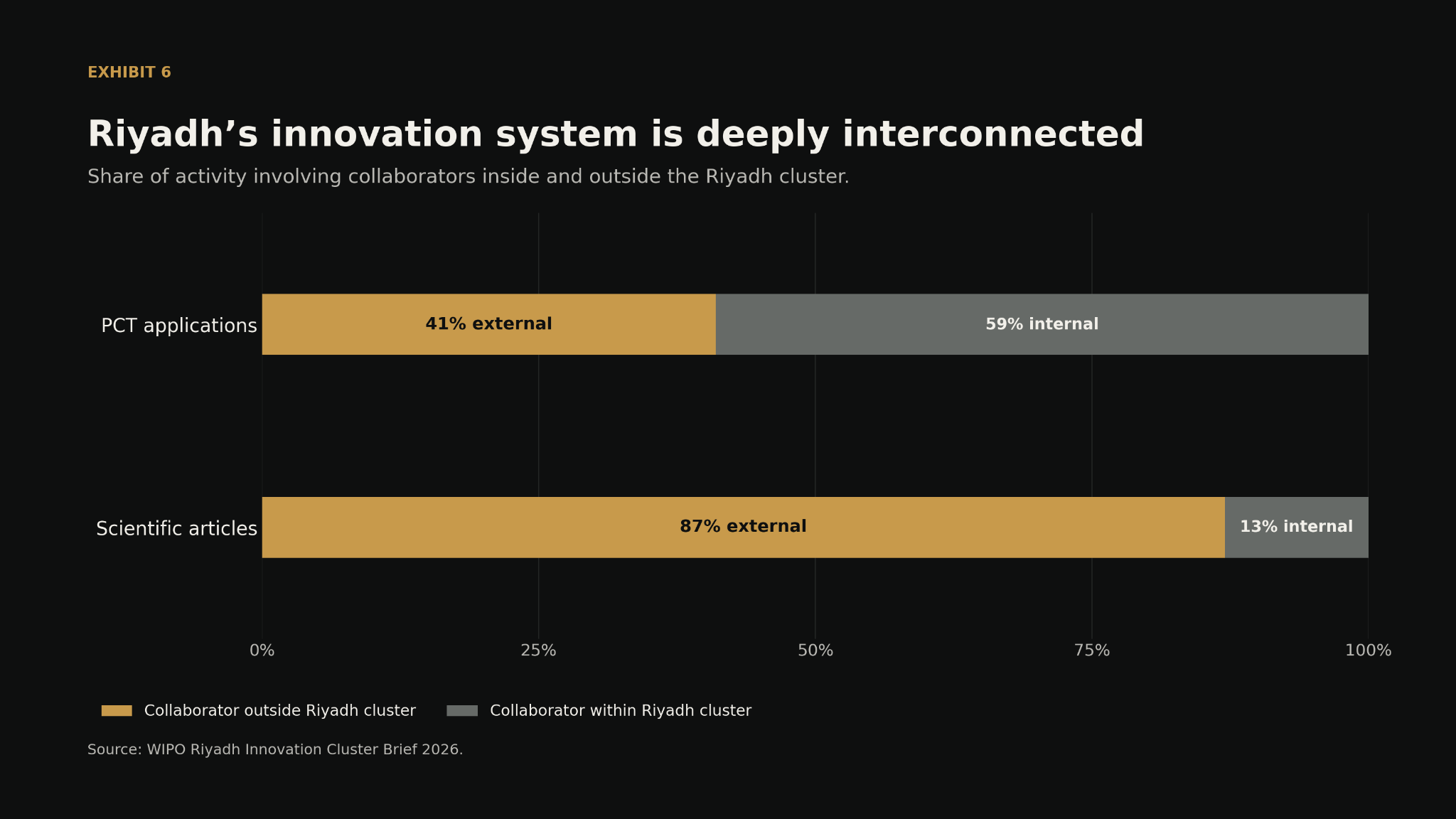
This degree of interconnection should not be interpreted as a structural weakness.
Innovation leadership has rarely depended on isolation. The most advanced ecosystems rely on international scientists, capital, suppliers, markets and research networks.
The relevant sovereignty question is therefore different:
What capability remains inside the system after each external interaction?
Foreign technology can remain an imported dependency—or generate local engineering capability.
International research can remain a publication relationship—or create Saudi IP and commercial teams.
Foreign investment can remain financial capital—or generate suppliers, operators and experienced founders.
Strategic partnerships can provide temporary access to capability—or progressively expand domestic agency.
Avion's concept of strategic interdependence is therefore central to this next phase. Sovereignty does not require owning every component of a system. It requires sufficient control, knowledge, optionality and institutional agency to determine how critical capabilities are accessed, combined and regenerated.

The 2026–2030 PIF strategy provides perhaps the clearest institutional expression of this transition.
PIF describes its current phase as a shift from growth and acceleration toward value realization and ecosystem integration. More importantly, it states that its role is evolving from the primary engine of growth toward the architect and steward of platforms that enable others to scale.
PIF's ecosystem model also explicitly describes selective capital deployment to establish scale, reduce early-stage risk and anchor demand before private operators and investors lead expansion.
For Sovereign Innovation, this matters more than the amount of capital deployed.
Early in an economic transformation, sovereign capital often has to create markets that do not yet exist. It can establish infrastructure, absorb early risk, form anchor companies and create sufficient demand to attract global capability.
But a mature sovereign system ultimately needs to produce independent organizations capable of allocating capital, undertaking R&D, entering markets and scaling without requiring the state to coordinate every transaction.
The strategic progression can therefore be understood as:
sovereign capital as builder → sovereign capital as market maker → sovereign capital as ecosystem architect → private capability as compounder.
This represents not a retreat of the sovereign, but an increase in the leverage of sovereign intervention.
The highest-value sovereign investment may ultimately be the investment that makes subsequent sovereign intervention less necessary.
Saudi Arabia possesses another structural advantage: many of its strategic challenges are sufficiently large to create commercially meaningful markets.
Water security, industrial decarbonization, energy systems, food production, mining, healthcare, logistics, advanced manufacturing and future cities are simultaneously national priorities and potential technology markets.
RDIA's own national priorities explicitly connect sustainable access to water, food and energy with the ambition to develop globally exportable technologies, while its Energy and Industrial Leadership agenda targets higher-value manufacturing and industrial technologies.
This creates an opportunity to turn national procurement into a capability-building mechanism.
The conventional pathway is: national problem → procurement → imported solution.
A sovereign innovation pathway is more demanding: national problem → research → domestic capability → IP → company → first customer → scale → export → reinvestment.
The second pathway addresses the immediate requirement while also creating a durable domestic capability.
That distinction is central to regenerative innovation.
The world's leading innovation clusters were not produced by a single successful program.
Their advantage comes from repeated cycles.
Companies create experienced technical talent. Some of that talent becomes entrepreneurial. Successful founders become investors. Suppliers acquire specialist expertise. Universities interact with companies that have real commercialization experience. Customers become sophisticated buyers of innovation. Capital providers learn which technical and commercial risks matter.
Each cycle changes the capability of the system undertaking the next one.
Saudi Arabia's opportunity is therefore to measure not only the stock of innovation assets, but the rate at which experience circulates between them.
A stronger national capability dashboard would track university spinouts that survive beyond initial funding; patents converted into revenue; private-sector R&D outside the largest incumbents; second- and third-time founders; engineers leaving established firms to create new ones; procurement awarded to Saudi-origin technology; international revenue generated by Saudi IP; domestic suppliers graduating into exporters; and private capital willing to finance these companies without public de-risking.
Those metrics would answer a more consequential question than the number of accelerators, patents or startups created:
Is the innovation system becoming better at producing the next generation than it was at producing the last?
That is the operational definition of compounding.
Avion's framework views Sovereign Innovation as a systems-design problem rather than a technology-policy category.
Capital is an input.
Technology is an input.
Talent, infrastructure, institutions and markets are inputs.
They become strategically valuable when orchestrated into three higher-order characteristics:
Architecture — the institutional and economic structures that allow capabilities to interact.
Capability — the accumulated ability to perform important functions repeatedly and at increasing levels of sophistication.
Agency — the ability to choose, adapt, negotiate, redirect and act without structural dependence on a single external actor.
When these characteristics reinforce one another, the result is what we describe as Regenerative Sovereignty: a system in which today's investments increase tomorrow's capability set rather than simply consuming today's resources.
For Saudi Arabia, the strategic implication is straightforward.
The Kingdom has demonstrated that it can deploy capital quickly, construct institutions at scale and mobilize national priorities.
The next phase is to ensure that those investments generate capabilities that persist, diffuse and reproduce.
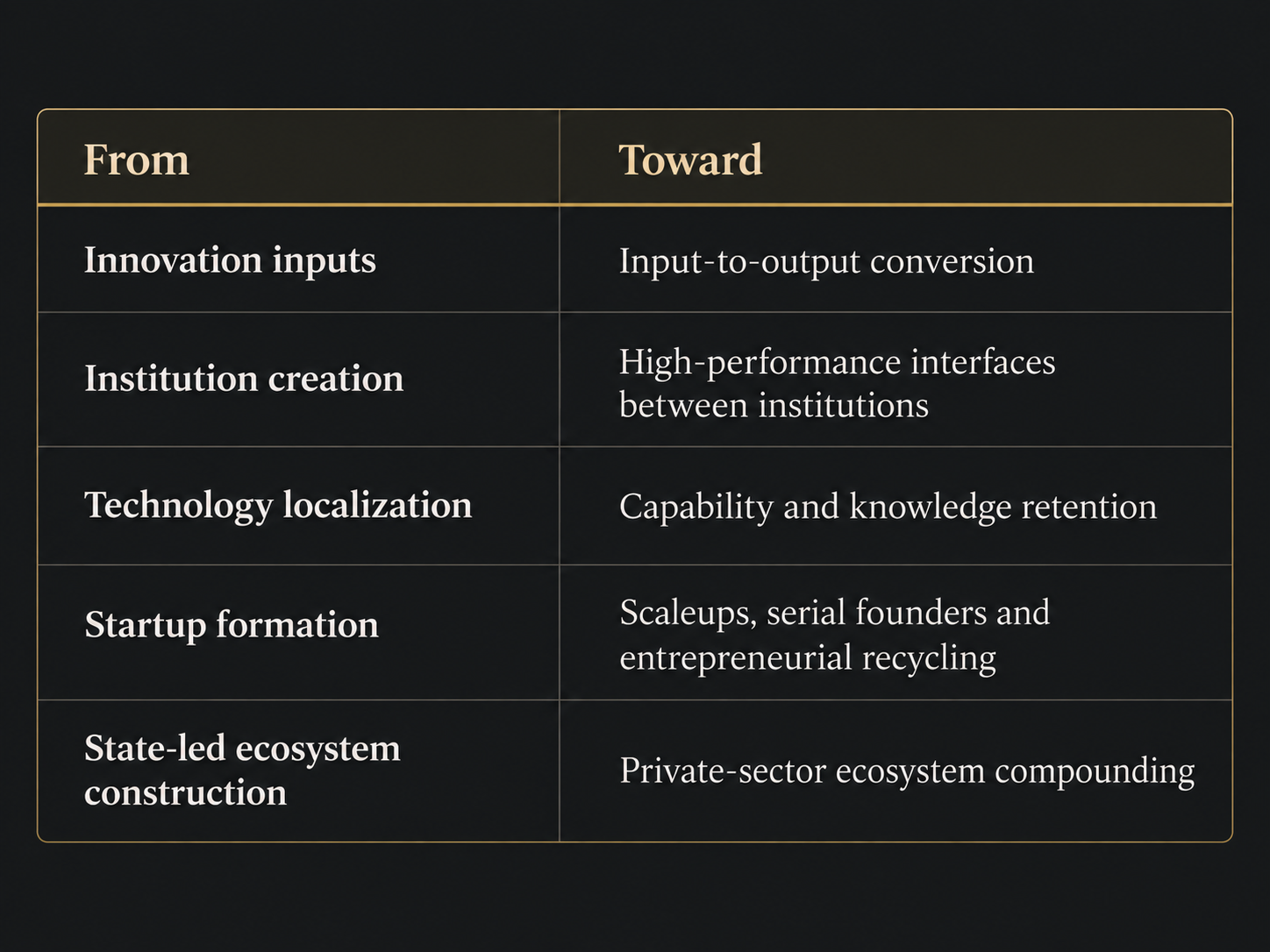
These shifts do not replace the architecture already built. They extract greater returns from it. The objective is not less government capability. It is to increase the amount of independent national capability generated per unit of public capital, procurement, partnership and research expenditure.
Riyadh moving from 92nd to 70th or 50th in the WIPO cluster ranking would be useful external validation. It should not be the primary objective. A more meaningful test would be whether Riyadh and the broader Saudi innovation system can begin producing repeatable sequences of:
research → IP → firm → customer → scale → international market → reinvestment → next firm.
The transition becomes visible when Saudi-origin companies undertake meaningful R&D from internally generated cash flows; when university intellectual property routinely becomes operating businesses; when major industrial companies produce alumni who found new technology firms; when private investors finance the second generation without needing the same level of catalytic public intervention; and when international partnerships increasingly produce Saudi-owned capability rather than access alone.
At that point, the Kingdom is no longer only constructing an innovation ecosystem.
At that point, ecosystem development begins to become increasingly self-reinforcing.
This is also why Riyadh's entry matters beyond Saudi Arabia.
The 2026 data exposes an increasingly important distinction between national innovation capacity and local innovation density.
The UAE ranks 25th globally in the 2026 GII and 12th for innovation inputs—materially ahead of Saudi Arabia's national positions of 42nd and 30th. Yet Saudi Arabia now has a top-100 innovation cluster through Riyadh. WIPO simultaneously identifies both countries, alongside Qatar, as having a continuing opportunity to improve the conversion of strong inputs into innovation outputs.
The comparison should not be framed as one ecosystem being ahead of another.
Their structural advantages are different.
Saudi Arabia combines domestic scale, industrial demand, major national champions, sovereign capital and increasingly concentrated research activity.
The UAE combines global connectivity, international talent, financial infrastructure, sovereign investment capability and unusually strong conditions for entrepreneurship.
For Abu Dhabi in particular, the question is not whether it can reproduce Riyadh.
It is whether its combination of sovereign capital, energy and industrial platforms, research institutions, AI capability and international networks can be orchestrated into a higher-density system for originating and compounding technological capability.
That is the subject of Part II.
The Gulf's next innovation advantage may ultimately depend less on which city climbs highest in an individual ranking than on whether the region can combine specialization, competition and strategic interdependence without collapsing them into another layer of centralized coordination.
Riyadh's arrival in the top 100 provides an important signal.
It shows that concentration is beginning.
The next strategic question—for Saudi Arabia, Abu Dhabi and the wider GCC—is where that concentration compounds fastest, and what new capabilities it leaves behind.