
The systems that create the most complex forms of value are rarely self-contained.
An enterprise may own its brand, intellectual property and customer relationships while relying on external cloud infrastructure, payment systems, research institutions, logistics networks, capital providers and specialist talent.
A country may possess legal authority and natural resources while depending on imported technology, external expertise and infrastructure it cannot independently operate or replace.
This is not necessarily weakness.
Specialization, shared infrastructure and access to scarce knowledge can make a system more capable than it could ever become alone.
The problem appears at the extremes.
Trying to internalize every strategically important capability is slow, expensive and often incompatible with the pace of change. Outsourcing aggressively in the name of efficiency can create the opposite problem: knowledge, bargaining power, technical judgment and credible alternatives gradually leave the system.
The relevant question is therefore not:
How independent are we?
It is:
Does the architecture of our interdependence expand or constrain our capacity to choose?
Traditional ecosystem strategy asks which actors must work together to create value.
Regenerative Sovereignty adds another question:
After they work together, where do capability, intelligence, agency and optionality accumulate?
That distinction matters because value creation and sovereignty creation are not the same.
A technology platform can expand access while concentrating control. A partnership can accelerate growth while hollowing out internal judgment. A supply network can reduce costs while eliminating practical alternatives.
The objective is therefore not simply to participate in an ecosystem.
It is to architect one.
Ecosystem Architecture is the deliberate design of relationships, capabilities, incentives and infrastructure across multiple actors to produce a shared system outcome while preserving meaningful agency.
This produces what Avion describes as the Ecosystem Advantage: the ability to orchestrate more capability than the system could efficiently own while retaining the intelligence, optionality and resilience required to change direction.
"Connection should increase capability without eliminating choice.”
This requires a more precise approach than make-or-buy.
Some capabilities should be owned. Some require control without ownership. Others are best developed through partnership, reliably accessed, selectively automated, or deliberately regenerated through repeated use and learning.
The advantage lies in choosing the right relationship for each capability.
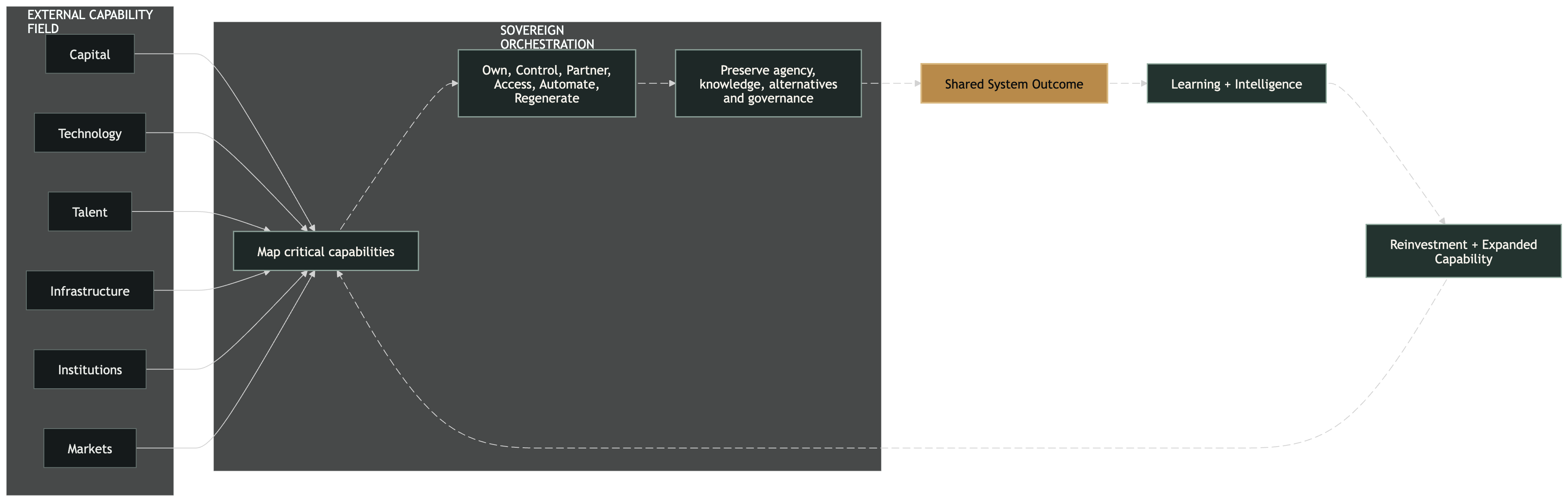
Every ecosystem contains two architectures.
The first is the architecture of value creation: who contributes what and how the pieces combine.
The second is the architecture of sovereignty distribution: who accumulates knowledge, customer access, technical understanding, decision authority, standards-setting power and future options.
The strongest ecosystems manage both deliberately.
Four design principles matter most:
This is where Systems Design, Capital Allocation and Sovereign Innovation converge.
Systems Design reveals the actors, dependencies and interfaces beneath the outcome. Capital Allocation funds not only visible assets, but also shared infrastructure, alternatives, talent and institutional capacity. Sovereign Innovation ensures that new value strengthens the capabilities required by the next cycle.
The goal is not independence.
It is strategic interdependence: participating deeply in networks while preserving sufficient agency to adapt, reconfigure and choose again.
The future will not belong to systems that attempt to own everything.
It will belong to those that understand what they must own, what they must control, what they can share, what they can access—and what they must continuously regenerate.
Ready to design an ecosystem that compounds capability?
Avion Advisors works with companies, investors, institutions and governments to architect strategic ecosystems that expand capability while preserving agency, optionality and future choice.