Riyadh’s entry into WIPO’s global top 100 innovation clusters reframes the innovation question for the Gulf. Across the GCC, governments have made substantial progress in building the conditions associated with knowledge-intensive economic development, including digital infrastructure, research institutions, startup finance, intellectual-property frameworks and mechanisms for attracting global talent and technology. The next phase is structurally different. It will depend less on the volume of innovation inputs that each economy can assemble and more on the effectiveness with which those inputs are converted into intellectual property, commercially viable firms, technical organizations, export capability and experienced entrepreneurs capable of initiating subsequent cycles of innovation.
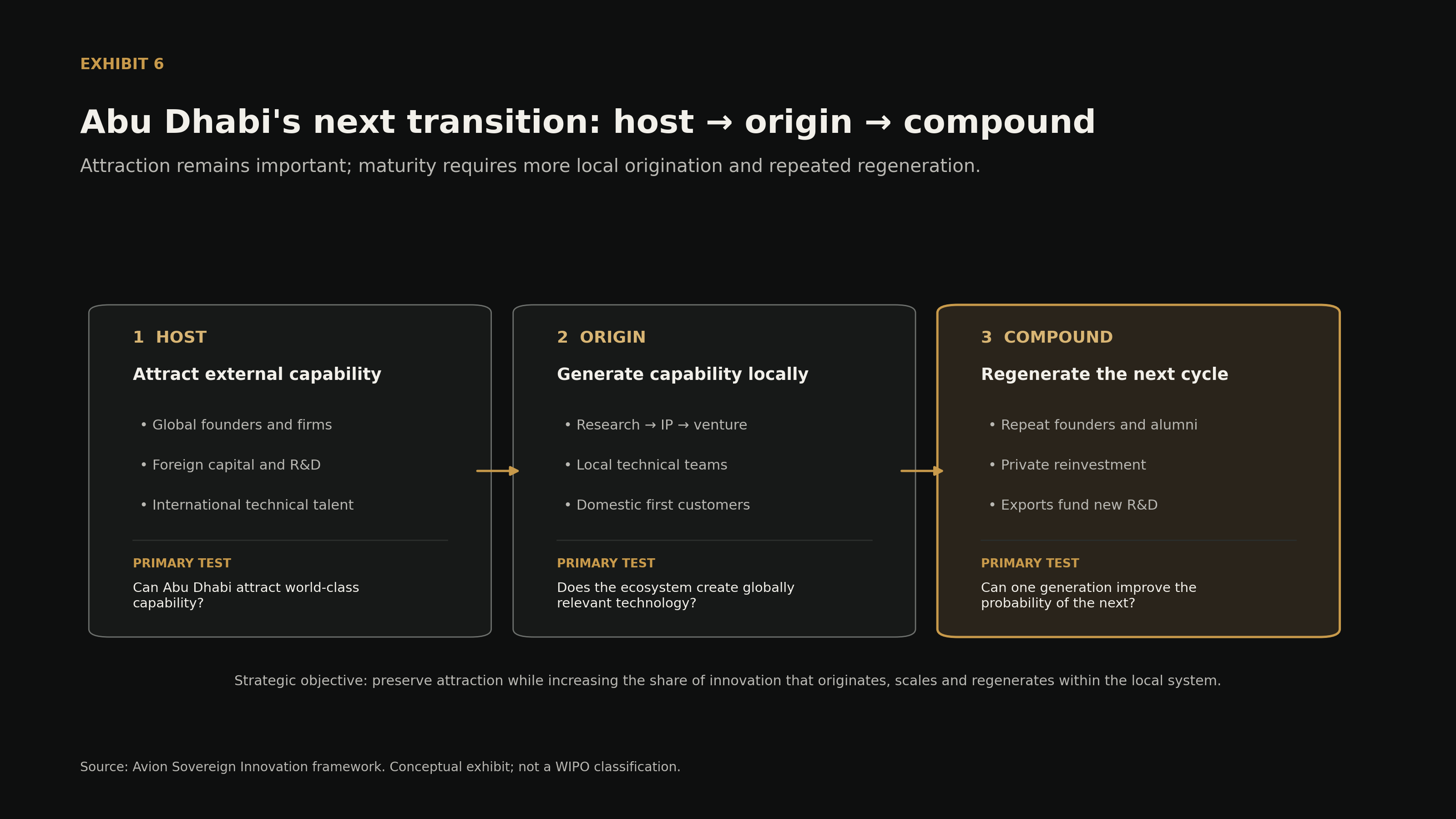
For Abu Dhabi, this transition is particularly consequential. The emirate combines sovereign investment capacity, research institutions, advanced industrial platforms, significant domestic demand and access to global technology networks within an unusually concentrated institutional environment. Its strategic opportunity is therefore not simply to attract more innovation activity, but to increase the proportion of that activity that originates, commercializes, scales and regenerates within the local economy. That distinction—between hosting capability and accumulating it—is central to the next stage of Sovereign Innovation.
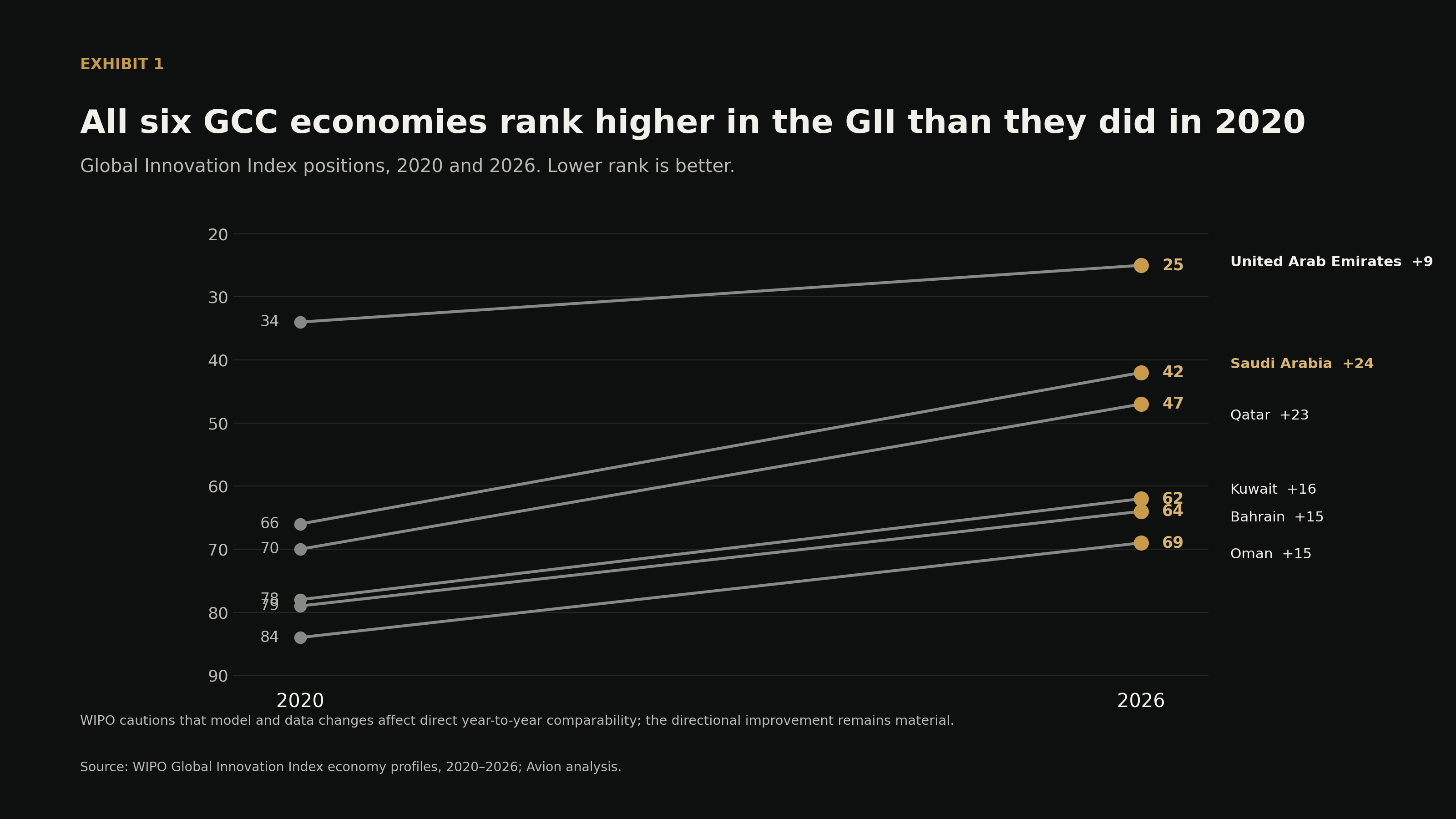
The Gulf’s innovation economies are entering a second phase of development. The first was principally concerned with building the enabling conditions for innovation: high-quality infrastructure, digital government, universities, financial markets, entrepreneurship frameworks, international connectivity and access to global talent. That process has generated measurable progress. In WIPO’s 2026 Global Innovation Index, the United Arab Emirates ranks 25th globally, Saudi Arabia 42nd, Qatar 47th, Kuwait 62nd, Bahrain 64th and Oman 69th. WIPO identifies Saudi Arabia, Qatar and Bahrain among the economies that have recorded some of the strongest sustained advances since 2019, while Kuwait has entered the global top 70 and the UAE has entered the top 25.
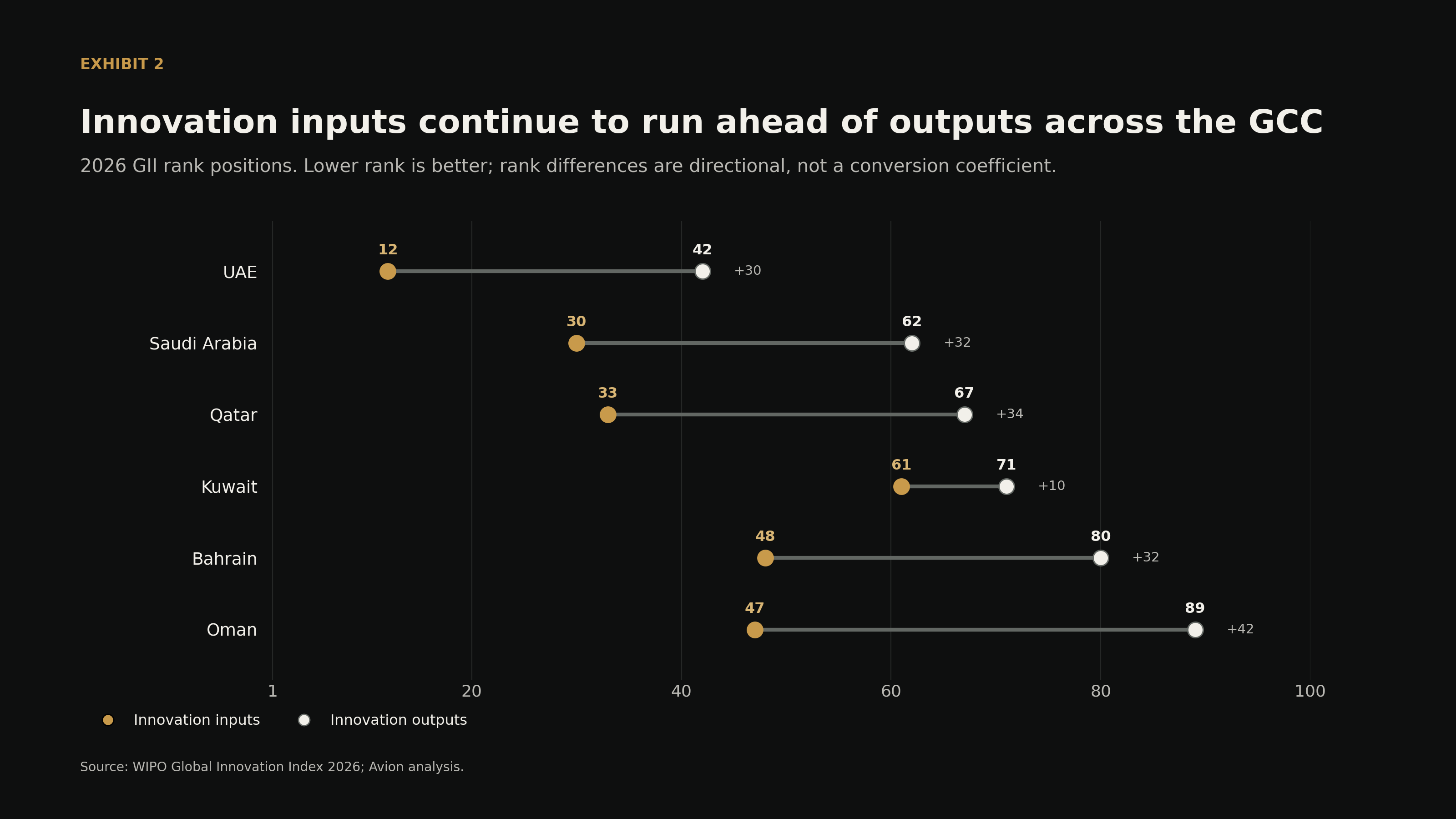
The underlying composition of that progress, however, is as important as the rankings themselves. Much of the Gulf’s advancement remains input-led. The UAE ranks 12th globally for innovation inputs but 42nd for outputs, while Saudi Arabia ranks 30th and 62nd respectively. Bahrain’s corresponding positions are 48th and 80th, and Oman’s are 47th and 89th. WIPO explicitly identifies the conversion of strong institutional, infrastructure and investment foundations into innovation results as a continuing challenge for several Gulf economies.
This distinction suggests that the Gulf is moving from an innovation-input problem to an innovation-conversion problem. The relevant strategic question is no longer simply whether an ecosystem possesses research institutions, capital, founders or technology infrastructure. It is whether those assets interact frequently and productively enough to create enduring intellectual property, commercially independent companies, technical teams, suppliers, experienced founders and private pools of reinvestment capital.
The implications differ across the six economies because their starting configurations are not identical. Saudi Arabia’s challenge is to convert state-built capacity and industrial demand into increasingly autonomous private capability. Qatar must deepen the commercialization of scientific and international talent. Kuwait must broaden firm-level R&D and organizational innovation capacity. Bahrain can leverage its regulatory and financial architecture through focused specialization. Oman has an opportunity to convert foreign investment and industrial infrastructure into cumulative engineering capability. The UAE, meanwhile, has built the Gulf’s strongest overall enabling environment and therefore presents the region’s most revealing conversion question: whether exceptional strength in attraction, finance and international connectivity can be translated into a larger base of locally originated technology, intellectual property and entrepreneurial regeneration.
Within the UAE, Abu Dhabi is a particularly important test case. It already contains many of the institutions normally associated with a high-capability innovation system. The strategic challenge is increasingly not institution formation, but interface performance: the effectiveness with which research becomes intellectual property, intellectual property becomes companies, companies reach institutional customers, domestic deployment becomes international scale, and successful operators and founders return talent and capital into the next cycle.
For much of the past decade, innovation policy across the GCC appropriately concentrated on constructing missing foundations. Governments invested in research universities, digital infrastructure, regulatory reform, entrepreneurship programs, venture capital, free zones, intellectual-property systems and mechanisms for attracting global companies and technical talent. These interventions addressed genuine structural gaps and helped transform the region into a materially more sophisticated environment for innovation-intensive economic activity.
WIPO’s 2026 results indicate how far this process has advanced. The UAE now ranks first globally for entrepreneurship policies and culture, startup and scaleup finance, tertiary inbound mobility and greenfield R&D and high-technology foreign direct investment. Saudi Arabia ranks first for ICT use, second for startup and scaleup finance and fourth for government online services. Qatar leads globally in tertiary inbound mobility and ranks 16th for infrastructure, while Kuwait ranks fourth in ICT access and third in ICT use. Bahrain leads globally in ICT access, and Oman ranks ninth in FDI inflows and 14th in WIPO’s measure of cluster development.
These indicators describe a region that has become increasingly effective at creating favorable conditions around innovation. They do not, however, establish that the resulting systems have reached the same level of maturity in generating scientific, technological and commercial outputs. The distinction matters because the policy response to an input shortage differs materially from the response to a conversion constraint. The former requires additional resources or institutions; the latter requires higher-performing relationships between assets that already exist.
This is also why rankings should be interpreted carefully. A gap between input and output rankings is not itself a mathematical measure of innovation efficiency, because ordinal positions are not equivalent units. It is nevertheless directionally informative when combined with the underlying indicators and WIPO’s own assessment of the region. The broader evidence suggests that the Gulf’s next productivity frontier lies increasingly in improving the conversion mechanisms between research, capital, companies, customers and markets.
The GCC is often discussed as though its innovation economies were interchangeable. In practice, each has assembled a distinct combination of assets, institutional advantages and structural constraints. This matters because a strategy designed for one ecosystem may be poorly suited to another.
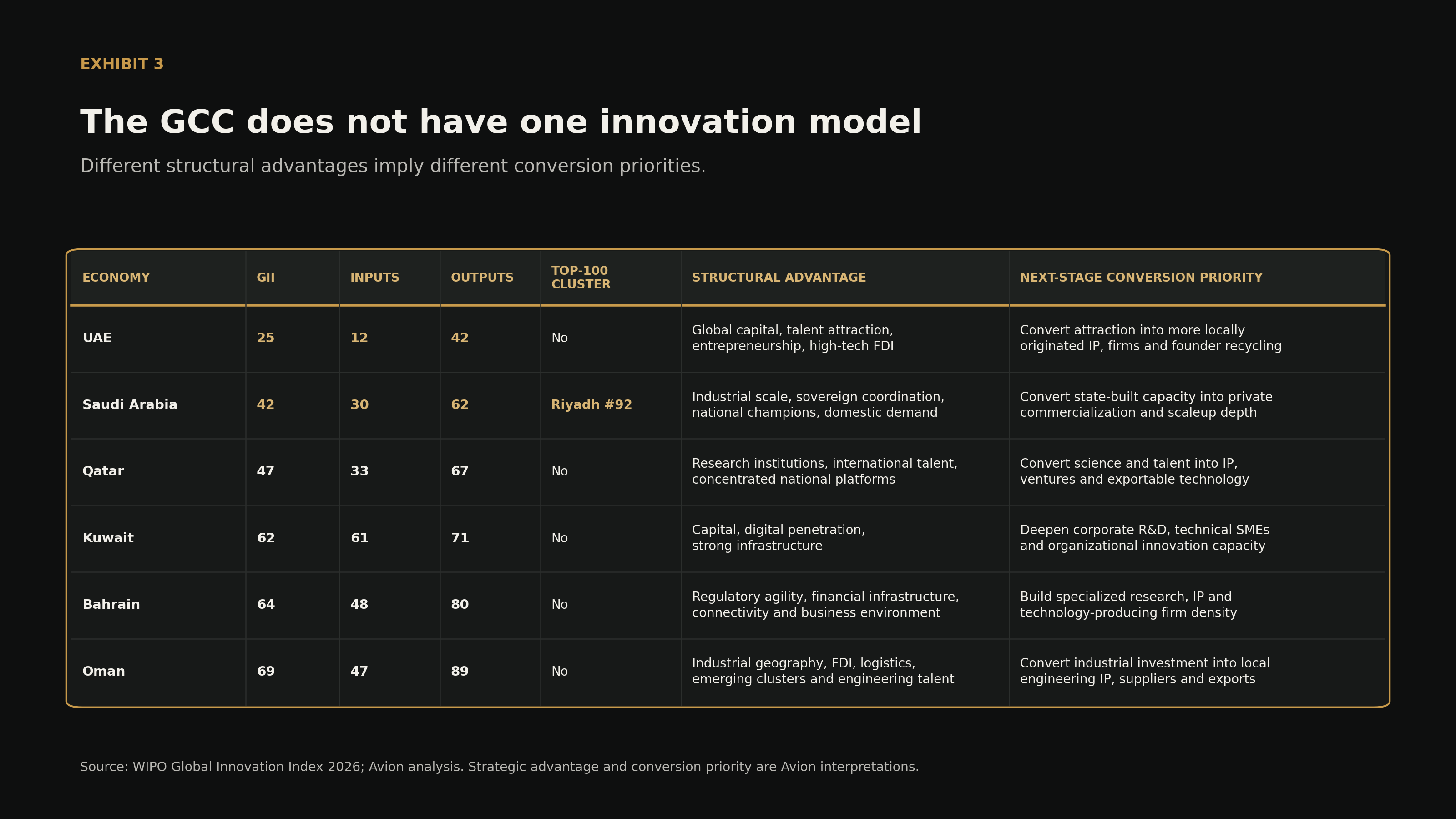
The strategic implication is that the Gulf should not aim to produce six replicas of a single global innovation model. The region would be better served by ecosystems that develop differentiated capabilities appropriate to their economic structures while maintaining sufficient interoperability to access complementary capabilities elsewhere in the GCC. Such an architecture would preserve competition between jurisdictions while reducing unnecessary duplication in areas where frontier innovation increasingly requires scale.
Qatar has constructed an unusually strong institutional and research environment for an economy of its size. It ranks 47th overall in the 2026 GII, with infrastructure at 16th globally and tertiary inbound mobility ranked first. Its institutional and research platforms provide substantial access to international scientific talent and sophisticated research capacity. At the same time, WIPO continues to identify a significant separation between Qatar’s enabling environment and its knowledge and technology outputs.
The implication is not that Qatar requires another layer of research infrastructure. The higher-value opportunity lies in increasing the frequency with which research becomes intellectual property, research teams become ventures, industry becomes a commercialization partner, and successful ventures reach markets beyond the domestic economy. For a relatively small state, specialization is likely to be particularly important. Concentrating scientific and commercial resources around a narrower set of areas in which Qatar can sustain world-class research and create credible first-customer markets may generate greater cumulative capability than attempting to replicate a broad innovation ecosystem across many unrelated fields.
Kuwait presents a different configuration. Its rise to 62nd in the 2026 GII has been supported by exceptionally high levels of digital access and use, together with improvements in investment and financing conditions. WIPO nevertheless continues to identify a comparatively thinner base of R&D and industrial diversification. This suggests that Kuwait’s next-stage problem is less about access to technology than about the number and sophistication of domestic organizations capable of creating, adapting and commercializing it.
For Kuwait, sovereign capital could therefore play a larger capability-building role if selected international investments, corporate partnerships and portfolio relationships are connected more systematically to domestic technical learning. The objective would not be to repatriate every capability financed abroad, but to use international access to develop local management expertise, specialist suppliers, corporate R&D functions and technical firms in sectors where Kuwait has a credible long-term economic rationale.
Bahrain illustrates the value—and the limitations—of a highly effective enabling environment. It ranks 64th globally, with innovation inputs at 48th and outputs at 80th. The country has particularly strong digital connectivity and a well-developed commercial and financial architecture, but it does not yet exhibit comparable depth in knowledge production and technology-oriented firm formation.
For a small economy, this does not necessarily imply that broad-based scientific scale should become the principal objective. Bahrain may be better positioned to develop disproportionate capability in selected domains where regulatory sophistication, financial infrastructure and cross-border services are themselves sources of competitive advantage. Under such a model, the innovation asset is not simply the technology produced domestically, but the ability to create an unusually efficient environment for testing, governing, financing and scaling particular classes of technology.
Oman provides a further variation. Its innovation inputs improved to 47th globally in 2026, while outputs remained at 89th. WIPO identifies strengths in FDI inflows, cluster development, electricity infrastructure, science and engineering graduates and university–industry R&D collaboration. Its weaker indicators include production and export complexity, software spending and knowledge and technology outputs more broadly.
This profile points toward a more industrial pathway to Sovereign Innovation. Oman’s ports, logistics infrastructure, energy platforms, minerals and industrial zones create environments in which technical learning can accumulate around physical operating systems. The relevant development sequence is therefore not necessarily startup formation in isolation, but the progressive conversion of foreign investment into local operating expertise, local operating expertise into specialized suppliers, and supplier capability into proprietary engineering knowledge and exportable services.
Taken together, these four economies demonstrate why the region’s next phase cannot be reduced to a common prescription such as “more venture capital” or “more R&D.” The problem is system-specific conversion.
The UAE occupies a different position from the rest of the GCC. At 25th globally, it is the region’s highest-ranked economy in the 2026 GII and has entered the global top 25 for the first time. Its innovation inputs rank 12th, institutions ninth, and human capital and research 13th. The country ranks first globally in entrepreneurship policies and culture, startup and scaleup finance, tertiary inbound mobility and greenfield R&D and high-tech FDI; it ranks second for the share of research talent employed in businesses and third for science and engineering graduates.
These indicators describe an unusually effective platform for attracting and enabling innovative activity. They help explain why the UAE has become a preferred regional location for technology companies, investors, entrepreneurs and specialized talent. They also make the remaining weaknesses more analytically useful. Patents by origin rank materially below the UAE’s overall position, as do several other indicators of domestically generated intellectual property, while innovation outputs overall rank 42nd.
The apparent contradiction is instructive. A country can be highly effective at hosting innovation without yet generating the same density of locally originated invention, scientific commercialization and technology-company formation found in mature clusters. WIPO’s geographic methodology reinforces this distinction. Its top-100 cluster ranking identifies concentrations of PCT inventors, scientific authors and venture activity rather than simply capital availability, business friendliness or technology adoption. In 2026, Riyadh became Saudi Arabia’s first cluster to enter the global top 100; the UAE is not represented in the ranking.
This should not be interpreted as evidence of weakness in the UAE ecosystem. It indicates that national innovation capacity and local innovation density are different strategic assets. The UAE has become exceptionally effective at assembling the former. The opportunity now is to translate more of that capacity into the latter.
Abu Dhabi provides a particularly useful case through which to examine this transition because the emirate has assembled many of the components associated with a frontier innovation system within a relatively concentrated geography. These include globally significant sovereign investment institutions, advanced industrial and energy platforms, major technology organizations, specialist research universities, startup infrastructure and government institutions capable of coordinating long-duration sector development.
The research layer has deepened substantially. MBZUAI, established as a specialized artificial-intelligence university, has expanded into a broader academic and research ecosystem and now reports more than 115 faculty and 653 students from 54 nationalities. It has also broadened its disciplinary base beyond its initial focus on machine learning and computer vision into areas spanning computing, engineering, life sciences and physical sciences.
The Advanced Technology Research Council adds a different component. ATRC’s mandate combines advanced research with the development and commercialization of priority technologies, creating an institutional bridge between scientific capability and applied outcomes.
The entrepreneurial layer has also reached greater scale. Hub71 reported 390 startups in its ecosystem by the end of 2025, while startups in its community had raised more than $2.7 billion and generated more than $1.5 billion in revenue. These figures indicate that Abu Dhabi has developed a credible platform for venture formation and growth rather than merely an early-stage accelerator ecosystem.
The strategic issue is therefore no longer the absence of components. It is the degree to which those components operate as an integrated system. An ecosystem becomes materially more valuable when the output of one institution routinely becomes the input of another: university research becomes licensable IP; research talent forms companies; sovereign and private investors finance commercialization; major local organizations become sophisticated first customers; and commercial success returns experienced employees and capital to the next generation.
Abu Dhabi’s next frontier is consequently interface quality rather than institution count.
Abu Dhabi has become highly effective at attracting externally developed capability. That is an important strategic achievement and should remain part of the model. International founders, researchers, technology companies and investors increase the quality and diversity of the local system, while foreign partnerships provide access to technical knowledge that would be inefficient or unrealistic to reproduce independently.
However, the long-term strategic value of attraction depends on what the ecosystem retains. A foreign company that establishes a sales office increases economic activity, but a foreign company that establishes an R&D mandate, develops local technical leaders, works with universities, forms suppliers and generates locally owned intellectual property creates a different order of capability.
The same principle applies to startups. Hub71’s ability to attract companies from around the world validates Abu Dhabi as an international operating base. The next phase requires a larger parallel flow in the opposite direction: research, talent and operational experience generated in Abu Dhabi producing companies that then expand internationally.
This is the distinction between a host ecosystem and an origin ecosystem. Mature innovation centers perform both functions simultaneously. They attract external excellence while continually creating new companies, technologies and founders of their own.
The National Founders Programme launched by Mubadala, Antler and Hub71 in 2025 is strategically relevant precisely because it addresses this interface. The programme is designed to translate university research into commercially viable technology ventures aligned with industry needs. Its significance therefore extends beyond the number of companies it may produce; it represents an institutional attempt to formalize the research-to-company conversion pathway that mature innovation systems perform repeatedly.
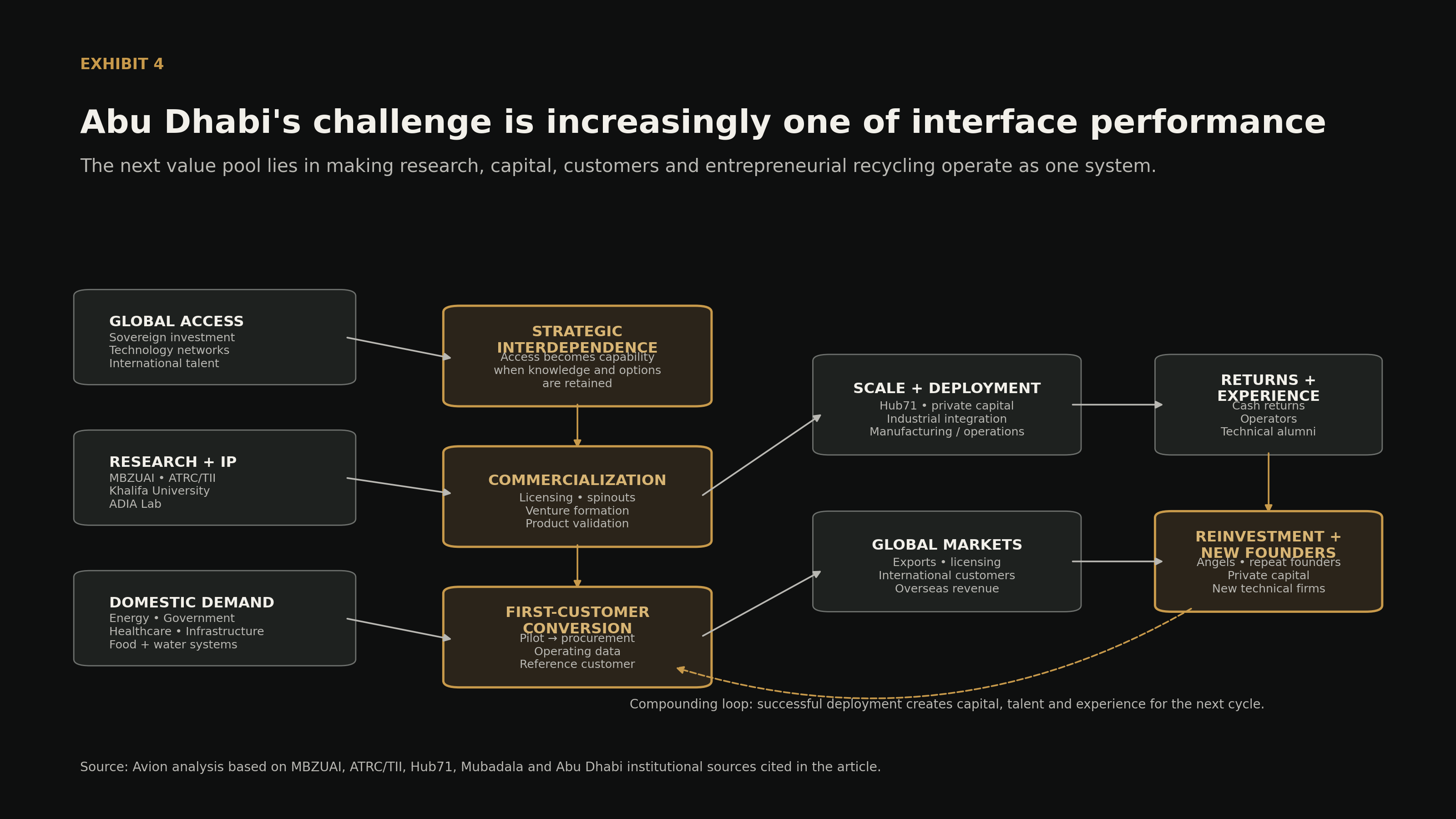
The development of innovation ecosystems often produces an institutional paradox. As ecosystems become more sophisticated, adding another program, accelerator, research center or investment vehicle may contribute less than improving coordination between those already present.
For Abu Dhabi, several interfaces appear especially important. The first is the relationship between research and intellectual property. Scientific excellence generates economic value when discoveries are systematically evaluated, protected, licensed and translated into products or ventures. The second is the relationship between ventures and major domestic customers. Deep-technology companies frequently require reference customers, regulated deployment environments and operational data before private capital is willing to finance scale. Abu Dhabi’s public and industrial ecosystem contains large organizations capable of providing these conditions.
A third interface concerns the transition from domestic deployment to external markets. A technology that solves a problem within the emirate becomes economically more valuable when the local deployment produces intellectual property, performance data, commercial references and operating knowledge that enable the company to sell the same capability internationally.
The fourth interface is entrepreneurial recycling. Ecosystems begin to compound when founders, senior engineers and investors from one generation become the founders, mentors and capital providers of the next. This mechanism is difficult to accelerate directly because it depends on time and repeated organizational experience. It can, however, be encouraged by making talent mobility, equity participation, corporate spinouts and private reinvestment structurally easier.
The relevant objective is therefore not simply more activity. It is a higher conversion rate between institutional stages.
Abu Dhabi’s international investment reach provides a further advantage. Sovereign investors can access global technology ecosystems, companies, capital markets and management teams at a scale that most emerging innovation centers cannot replicate. That access should not be reduced to a narrow localization agenda.
MGX illustrates the underlying logic. Its investment strategy spans semiconductors, digital infrastructure and AI technologies across a global portfolio. Approximately 70 percent of its capital is allocated to North America, with the remainder distributed across the UAE, Western Europe and selected Asia-Pacific markets.
The sovereign value of such investment cannot be assessed solely by asking what percentage of an asset is located domestically. A global investment can create financial returns while simultaneously expanding access to technical standards, scientific communities, supply chains, executives, infrastructure, future partnerships and co-development opportunities.
The strategically relevant question is therefore whether international exposure increases the number of credible options available to the domestic system. Where global relationships generate greater knowledge, bargaining power, supplier diversity, technical competence or alternative pathways to critical capability, international interdependence can increase rather than diminish sovereignty.
This is the distinction between dependence and strategic interdependence. Dependence narrows choice. Strategic interdependence expands it.
The emirate’s ability to generate large first-customer markets may ultimately prove as important as its ability to provide capital.
Research-intensive and industrial technology companies often face a commercialization constraint that venture finance alone cannot solve: they need sophisticated customers willing to deploy technologies before those technologies have accumulated long operating histories. Abu Dhabi’s public and industrial ecosystem spans major systems in energy, healthcare, government, logistics, infrastructure, food systems and advanced industry that can provide commercially meaningful testing and deployment environments.
The strategic value of procurement therefore extends beyond the immediate purchase of technology. When structured appropriately, domestic demand can help produce operating data, technical validation, engineering expertise, intellectual property and reference customers that subsequently improve a company’s ability to enter foreign markets.
This logic is particularly relevant to sector-based development. In areas such as AI, industrial automation, food and water systems, life sciences and climate technology, Abu Dhabi can combine regulatory capacity, research institutions, capital and institutional customers around real operating problems. Such environments create stronger commercialization conditions than innovation programs that remain detached from demand.
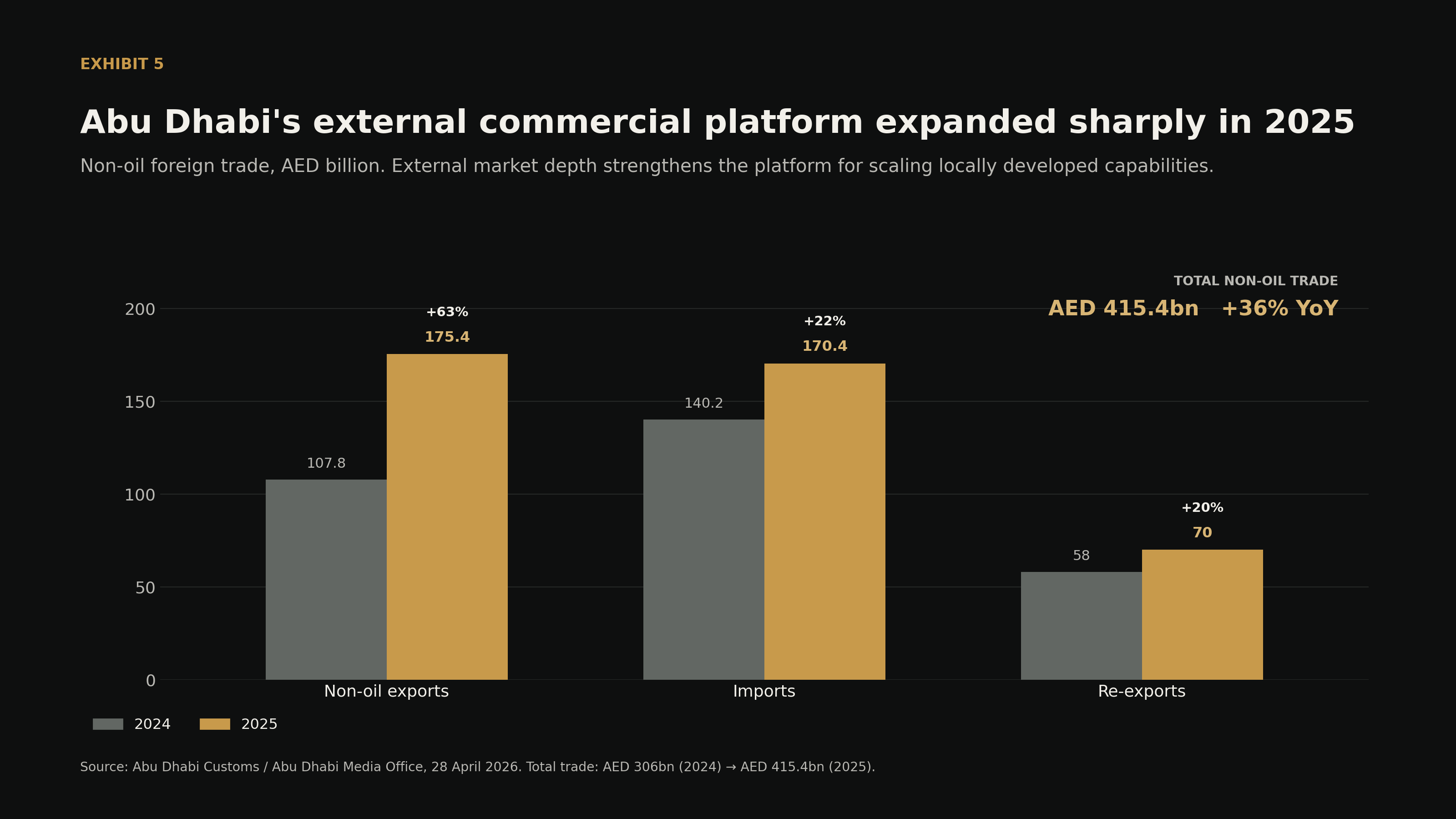
The wider economic context is increasingly supportive. Abu Dhabi’s non-oil economy grew 7.6 percent year-on-year in the third quarter of 2025. Separately, non-oil foreign trade reached AED415.4 billion in 2025, an increase of 36 percent from approximately AED306 billion in 2024, while non-oil exports rose 63 percent to AED175.4 billion. These figures do not measure technological innovation directly, but they indicate an expanding commercial platform through which locally developed capabilities can ultimately access external markets.
A sovereign innovation system therefore treats domestic demand not merely as consumption, but as commercialization infrastructure.
The UAE’s innovation system should also be considered at a level broader than any single emirate. Abu Dhabi and Dubai have developed different structural orientations, and the national system may become more competitive if those differences are treated as complementary rather than gradually erased.
Abu Dhabi’s innovation architecture is more heavily weighted toward sovereign capital, frontier research, energy, advanced industry, AI institutions and long-duration strategic investment. Dubai’s is more heavily weighted toward international commerce, professional services, global headquarters, entrepreneurship, financial markets, logistics and rapid access to regional customers.
These capabilities imply different but potentially mutually reinforcing roles. Abu Dhabi can deepen its position as an origin point for research-intensive and industrial innovation, while Dubai can provide additional pathways for commercialization, corporate sales, financing, regional expansion and international market access.
The objective need not be formal administrative integration. A more useful concept is functional integration. Research, capital, companies and talent should be able to move between the two ecosystems without unnecessary friction. A company should not have to choose between access to research infrastructure and access to commercial markets. A university spinout should be able to use customers and investors across the federation. Successful founders and executives should circulate between sectors and emirates.
In this model, the UAE’s national innovation advantage emerges not from forcing geographic concentration into a single city, but from making multiple concentrations operate as one interconnected capability system.
The same logic extends across the GCC.
Frontier innovation increasingly requires scale. Advanced scientific research depends on highly specialized talent. AI requires large amounts of computing infrastructure and capital. Life sciences require clinical systems, regulation and specialized research environments. Industrial technologies require manufacturing, testing facilities and sophisticated customers. Attempting to reproduce every component of these systems independently in six national markets risks dispersing precisely the density that innovation clusters require.
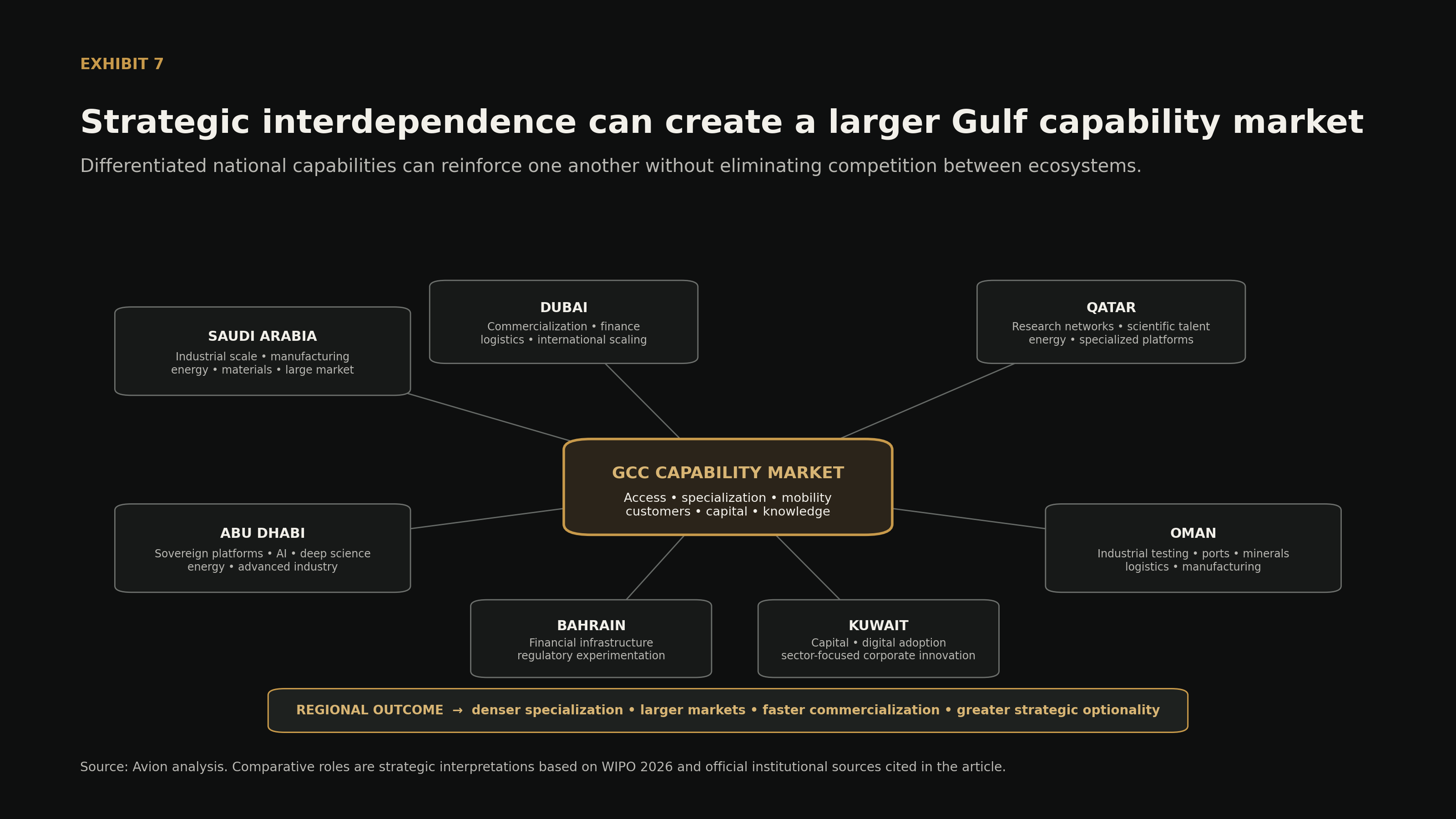
One plausible regional architecture would combine national specialization with cross-border access. Saudi Arabia can contribute industrial scale, manufacturing demand, materials, energy and a large domestic market. Abu Dhabi can deepen its role in sovereign investment, AI, advanced science, energy and industrial technology. Dubai can provide commercial, financial and global scaling capability. Qatar can contribute specialized research and international scientific networks. Oman offers industrial testing environments, logistics, ports, minerals and manufacturing potential. Bahrain provides financial and regulatory experimentation. Kuwait brings substantial capital and a highly digitized domestic economy.
This does not imply the creation of a centralized Gulf innovation bureaucracy. Such a structure could reduce competition, slow decision-making and replicate the institutional accumulation problem the region is trying to move beyond.
The more valuable objective is interoperability. Companies, researchers, investors and customers should be able to access complementary capabilities across the GCC while individual jurisdictions continue to compete on institutional quality, specialization and commercial attractiveness.
Regional competition and regional collaboration are therefore not contradictory. Competition improves ecosystems; interoperability enlarges the market in which those ecosystems operate.
Traditional innovation indicators understandably emphasize measurable stocks: R&D spending, patents, researchers, venture capital, companies and scientific publications. These metrics remain important, but they capture only part of how mature innovation systems develop.
The more difficult variable is circulation. Innovation capability compounds when people, knowledge and capital move repeatedly between organizations. A researcher becomes a founder. An engineer leaves a successful technology company to form another. An industrial customer develops internal expertise through deployment. A founder exits a company and becomes an investor. An international partner transfers enough knowledge for a domestic technical team to develop its own subsequent product.
These transitions capture something that raw ecosystem size does not: whether the system is learning from its own activity.
For Abu Dhabi and the wider Gulf, a next-generation capability framework should therefore measure not simply how many companies or institutions exist, but how often activity produces another cycle. Relevant indicators would include university IP converted into operating companies, second- and third-time founders, technology-company alumni forming new ventures, pilots converting to procurement, overseas revenue generated from locally developed IP, private capital invested without sovereign de-risking, and international partnerships that create durable local technical teams or intellectual property.
Such measures would not replace WIPO or traditional economic indicators. They would help explain the mechanisms through which those external indicators should improve over time.
Part I argued that Riyadh’s entry into the global top 100 matters because it suggests that previously separate elements of Saudi Arabia’s innovation architecture are becoming geographically concentrated enough to register as a measurable cluster. The more important question is whether that concentration becomes self-reinforcing. Riyadh entered WIPO’s top 100 at 92nd in 2026, becoming Saudi Arabia’s first cluster to do so.
The same analytical lens applies across the Gulf. The region has become increasingly effective at mobilizing financial capital, constructing infrastructure, building institutions and attracting globally mobile talent. Those achievements are substantial and remain necessary. They are no longer sufficient to define the next stage of competitive advantage.
The next phase will depend on whether each ecosystem can increase the amount of durable capability generated by each investment, partnership, research program and commercial deployment. A high-performing system should leave behind more than an asset or transaction. It should leave behind experienced people, organizational knowledge, intellectual property, supplier capabilities, revenue-producing firms and additional strategic options.
This is the progression from capacity to capability and from capability to compounding.
For Saudi Arabia, the priority is increasingly to convert large-scale state and industrial capacity into deeper private-sector autonomy. For Qatar, it is to translate research and international talent into more commercial outcomes. For Kuwait, it is to expand firm-level technical capability. For Bahrain, it is to turn regulatory and financial sophistication into specialized innovation advantages. For Oman, it is to convert industrial investment into cumulative engineering knowledge.
For the UAE, and particularly Abu Dhabi, the challenge is different because the enabling system is already unusually strong. The opportunity is to turn one of the world’s most effective environments for attracting capital, technology and talent into an equally effective environment for originating, commercializing and regenerating technological capability.
Riyadh’s entry into the top 100 should not be understood primarily as evidence that Saudi Arabia has moved ahead in a regional innovation competition. Its greater significance is that it makes visible a transition occurring across the Gulf.
The first phase of that transition was concerned with assembling the ingredients of modern innovation economies. Across the GCC, governments have built infrastructure, established institutions, strengthened digital systems, mobilized capital and increased access to global companies and talent. WIPO’s 2026 rankings confirm that these efforts have materially improved the region’s position within the global innovation landscape.
The second phase will be more demanding because it depends less on the creation of assets than on the quality of relationships between them. Research must convert into intellectual property and companies. Companies must gain sophisticated customers and reach external markets. Global partnerships must generate more than access; they must deepen domestic competence and optionality. Successful founders, engineers and investors must circulate back into the ecosystem and improve the probability of success for the generation that follows.
Abu Dhabi is particularly well positioned to test this model. Its combination of sovereign capital, advanced research, industrial platforms, international connectivity and institutional coordination gives it many of the prerequisites required for a globally relevant innovation node. The strategic priority is increasingly to connect those prerequisites into a system in which capability can move from research to commercialization, from deployment to export, and from one generation of institutions and companies to the next.
When that transition becomes routine, the character of the ecosystem changes. Innovation is no longer sustained primarily by the repeated construction of new programs and institutions. The system begins to generate its own firms, technical leaders, intellectual property, investors and subsequent opportunities.
That is the point at which ecosystem development becomes ecosystem compounding.
And it is the point at which Sovereign Innovation begins to mature into Regenerative Sovereignty.