
Three developments in October 2026 reveal an emerging structural transformation that extends beyond the pharmaceutical industry. Eli Lilly announced clinical results demonstrating substantial improvements in weight loss and glycaemic control from its next-generation metabolic therapy. Lotte Bjerre Knudsen, whose pioneering research helped establish GLP-1 medicines, argued in the Financial Times that the food industry must reconsider the needs of its future consumers. Meanwhile, a new agreement in Abu Dhabi to localise the packaging and distribution of metabolic medicines illustrated how pharmaceutical innovation is becoming connected to regional industrial development.
Viewed independently, these developments concern drug discovery, consumer behaviour and pharmaceutical supply chains. Viewed together, they suggest the early formation of a new economic system in which medical science can influence food consumption, nutritional requirements, healthcare expenditure and industrial investment.
For the Gulf Cooperation Council (GCC), where metabolic disease represents a substantial public-health challenge and food security remains a strategic priority, this convergence raises a more consequential question. Can countries move beyond importing innovative therapies and producing greater volumes of food toward developing the scientific, nutritional, agricultural and clinical capabilities required to improve long-term population health?
The opportunity is not simply to participate in the growing GLP-1 market. It is to build a metabolic-health economy in which pharmaceutical innovation, preventative healthcare, nutritious food production and advanced industrial capabilities reinforce one another.
A fourth development, reported on November 2, adds an important clinical perspective: Abu Dhabi’s personalised weight-management programme is demonstrating how medication, nutritional guidance, behavioural support and longitudinal care can be organised as part of a coordinated service model. Exhibit 1 places these four signals alongside one another. The chronology is not presented as proof of causation between the announcements; rather, it reveals the convergence of technological, commercial, clinical and industrial changes that had previously been assessed largely in isolation.
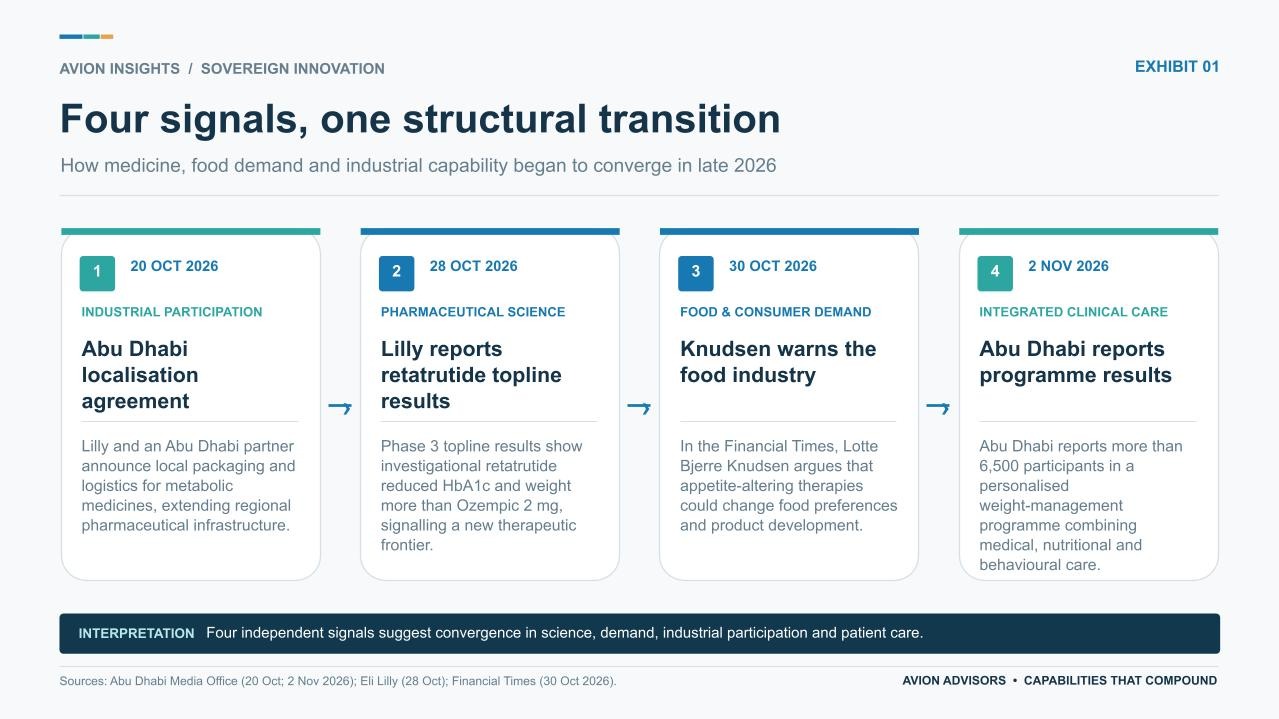
On October 28, 2026, Eli Lilly reported positive topline results from TRANSCEND-T2D-2, a Phase 3 clinical trial evaluating retatrutide against Novo Nordisk's Ozempic in adults with type 2 diabetes. Retatrutide, an investigational treatment that activates three metabolic hormone receptors—GLP-1, GIP and glucagon—achieved an average reduction in HbA1c of 2.2 percentage points over 80 weeks, compared with 1.8 percentage points for Ozempic 2 mg. Participants receiving the highest retatrutide dose experienced approximately 20.9% weight loss, compared with 9.4% in the comparator group.[1]
These results are significant, although retatrutide remains investigational and the detailed trial findings had not yet undergone peer-reviewed publication at the time of the announcement. They nevertheless illustrate the speed at which pharmaceutical innovation is advancing beyond traditional glucose management toward broader metabolic intervention.
Two days later, the Financial Times published an interview with Danish scientist Lotte Bjerre Knudsen, whose research at Novo Nordisk was instrumental in developing the GLP-1 therapies that helped transform the treatment of diabetes and obesity.
Knudsen's argument extended beyond the medical benefits of these therapies. By influencing appetite, satiety and potentially food preferences, GLP-1 medicines are changing how some consumers experience and evaluate food. She argued that the food industry must respond to a future customer whose relationship with consumption may differ substantially from the assumptions embedded in today's product development and retail models.[2]
The economic significance lies in the interaction between scientific progress and the demand structures of industries that did not originate the underlying innovation.
For decades, the global food industry has expanded through improvements in productivity, affordability, distribution, convenience and product availability. Many commercial models have been organised around stimulating consumption, increasing purchase frequency and improving the economics of volume.
Pharmaceutical innovation now introduces a different variable into that system: the possibility that biological interventions can materially influence consumer demand.
This represents a distinct form of disruption. The technology changing the market does not originate within the industry being disrupted. Instead, scientific progress in one sector is changing the demand conditions of another.
For food producers, manufacturers, restaurants and retailers, the implications extend beyond smaller portions. Product formulation, nutritional composition, purchasing patterns, packaging economics and supply-chain priorities may all require reconsideration.
For governments, the implications are broader still. A healthcare intervention that changes consumption can affect agricultural demand, food imports, domestic production, preventative-health expenditure and industrial development.
The relevant unit of analysis is therefore no longer the pharmaceutical product alone. It is the wider economic system through which the product creates secondary effects.
Early consumer evidence supports the proposition that GLP-1 therapies can influence food markets, although the pattern is more complex than a straightforward movement from processed foods toward healthier alternatives.
Research published in the Journal of Marketing Research, drawing on consumer survey responses and verified household transactions in the United States, found that households adopting GLP-1 medications reduced grocery expenditure by an average of 5.3% during the first six months of treatment. Spending on savoury snacks declined by approximately 10%, with reductions also observed across several other calorie-dense, processed-food categories.[3]
However, the study also found declining purchases across many conventional food categories, including some fresh products. Only a small number of categories experienced increases, with yoghurt showing the clearest statistically significant positive movement.
Exhibit 2 presents the two clearest aggregate signals from the household evidence: a 5.3% decline in grocery spending and an approximately 10% decline in savoury-snack spending during the initial six-month observation period. These are observed expenditure changes in the study sample, not forecasts of economy-wide food consumption, changes in nutritional status or long-term market growth. The exhibit therefore identifies a shift in purchasing behaviour while deliberately avoiding unsupported predictions about which food categories will ultimately gain share.
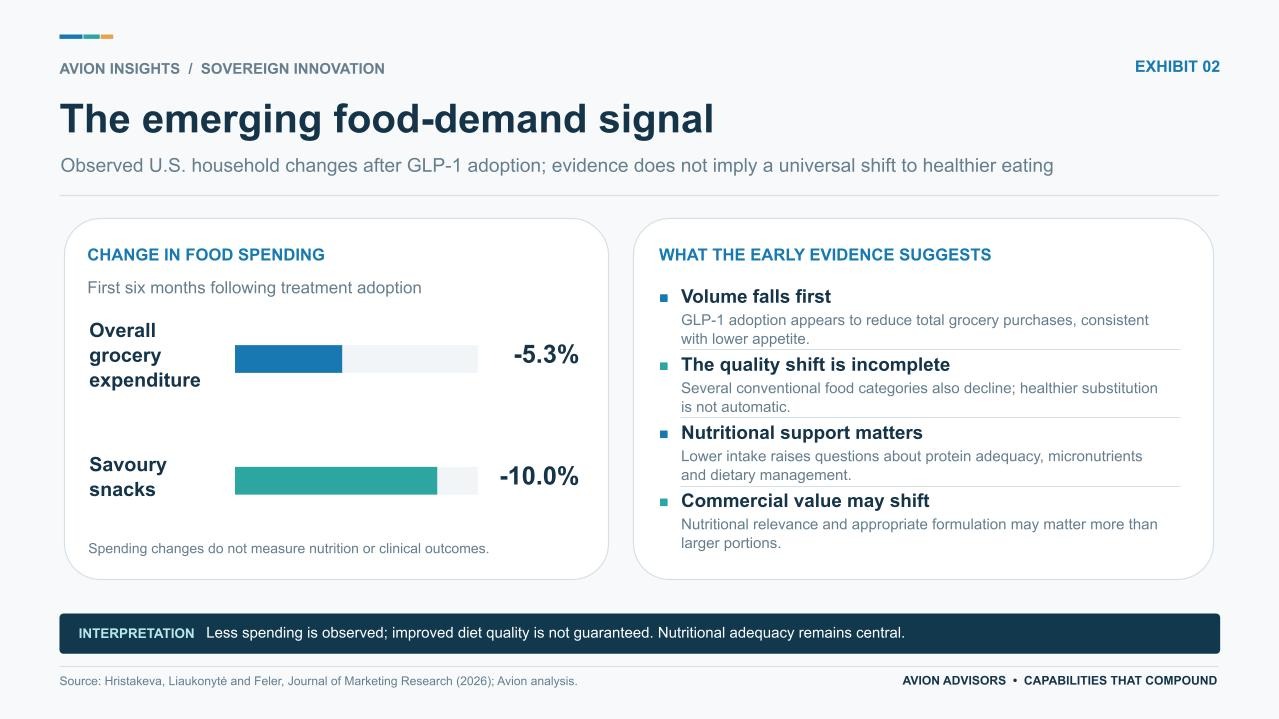
Reduced appetite can lower overall consumption without necessarily improving the nutritional quality of what remains. Consumers may purchase fewer processed foods, but they may also consume insufficient protein, fibre or micronutrients if dietary adjustments are not appropriately managed.
The commercial implication is therefore not that fresh-food producers will automatically benefit from declining demand for highly processed foods. Instead, the economic value associated with each eating occasion may become increasingly important.
Nutritional adequacy, ingredient quality, protein composition, digestibility and dietary suitability may carry greater weight relative to portion size and caloric volume. Manufacturers that previously differentiated primarily through convenience, taste and price may need to compete more explicitly on nutritional outcomes and product utility.
The evidence also introduces an important limitation. Researchers observed that some purchasing patterns moved back toward previous levels after medication discontinuation. This suggests that the long-term transformation of food demand will depend on treatment persistence, affordability, prescribing practices and whether changes in dietary behaviour endure.
The World Health Organization's 2025 guidance reinforces this distinction. It recognises GLP-1 therapies as an important option for treating obesity while emphasising that medication alone cannot resolve the broader causes of metabolic disease. Healthy dietary practices, physical activity and appropriate long-term support remain necessary components of care.[4]
The emerging opportunity is consequently not a pharmaceutical replacement for nutrition. It is the development of a food and healthcare system capable of supporting more sophisticated metabolic interventions.
The Gulf enters this transition with structural characteristics that distinguish it from many other markets.
Its economic model combines high urbanisation, extensive international food trade, substantial healthcare investment, sophisticated logistics networks and comparatively high burdens of metabolic disease. At the same time, the region faces persistent agricultural constraints associated with water scarcity, extreme temperatures and limited conventional arable resources.
These conditions have historically encouraged separate policy responses. Healthcare authorities have invested in medical treatment and disease management, while food-security strategies have emphasised import diversification, strategic reserves, agricultural technology and domestic production.
The metabolic transition creates an opportunity to connect these agendas more systematically.
According to the International Diabetes Federation's 2025 Diabetes Atlas, approximately 85 million adults were living with diabetes across its broader Middle East and North Africa region in 2024, with the number projected to reach approximately 163 million by 2050. The Federation estimated diabetes-related healthcare expenditure in the region at approximately USD 35 billion in 2024.[5]
The GCC’s age-standardised diabetes prevalence rates are particularly revealing because they establish the magnitude and regional distribution of the health challenge without presuming a direct relationship between diagnosis rates and pharmaceutical utilisation. Exhibit 3 compares the six member states on a consistent age-standardised basis.
Age-standardised diabetes prevalence among adults aged 20–79, 2024.
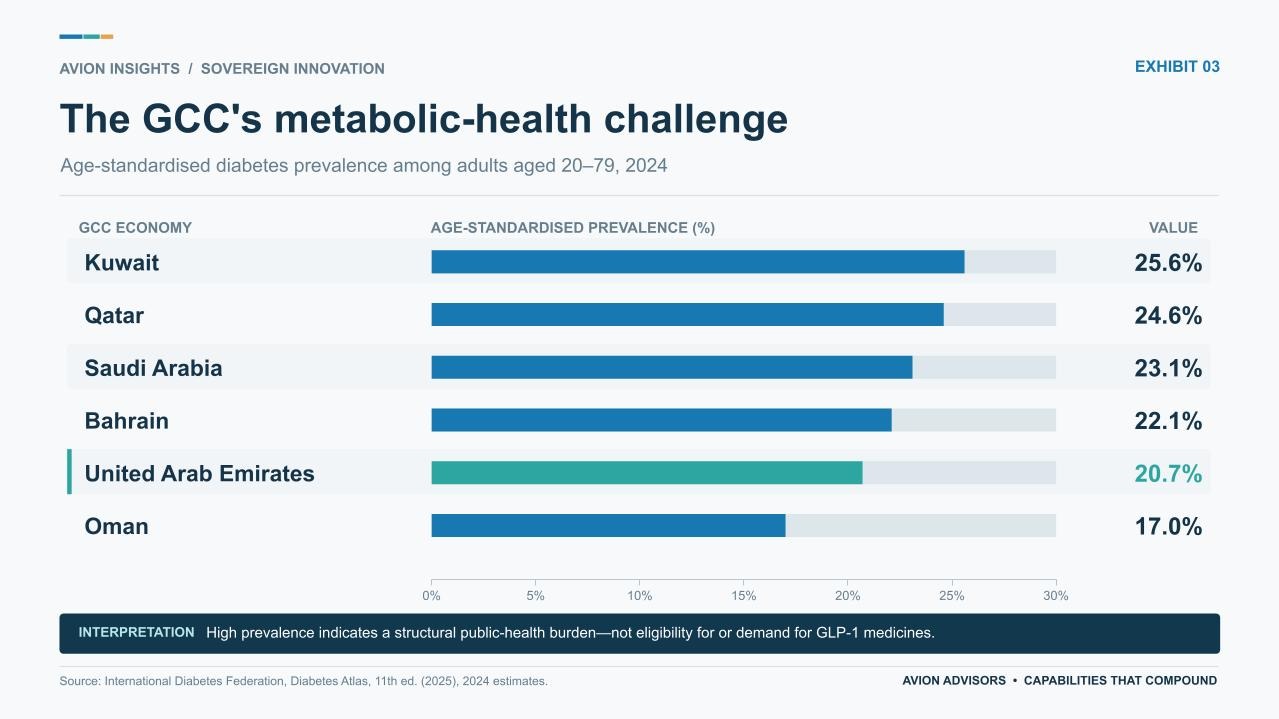
Kuwait records the highest age-standardised estimate in the comparison at 25.6%, followed by Qatar (24.6%), Saudi Arabia (23.1%), Bahrain (22.1%), the UAE (20.7%) and Oman (17.0%). The regional distribution strengthens the case for complementary public-health and industrial responses, but the prevalence estimates do not establish how much treatment capacity any one country will require.
The UAE alone had an estimated 1.27 million adults living with diabetes in 2024, with projections approaching 1.88 million by 2050. The scale of the challenge is significant even before considering obesity, prediabetes, cardiovascular conditions and other metabolic disorders.[5]
Yet disease prevalence should not be confused with a pharmaceutical market forecast. Not all people living with diabetes require or qualify for GLP-1 therapy, and not all metabolic conditions are best addressed through medication.
The more consequential economic question concerns the underlying relationship between population health and productive capacity.
Metabolic disease generates costs through clinical treatment, complications, reduced workforce participation, impaired quality of life and long-term healthcare obligations. Effective prevention and disease management can therefore create economic value beyond the revenues generated by medicines.
For countries seeking greater economic resilience and productivity, population metabolic health is not simply a healthcare expenditure category. It is an important determinant of human-capital quality and long-term institutional performance.
The Gulf's comparatively high disease burden consequently provides a substantial rationale for research, specialised services and nutritional innovation. Its domestic markets could also provide environments in which new approaches are developed, clinically validated and subsequently adapted for international deployment.
This creates a potential transition from healthcare consumption to healthcare capability formation.
Food security has traditionally been evaluated through availability, affordability, accessibility and stability of supply. Those dimensions remain essential, particularly for economies exposed to international trade disruptions and environmental constraints.
However, the metabolic transition introduces another important consideration: whether the food system consistently provides the nutritional quality required to sustain population health.
An economy can maintain adequate food availability while continuing to experience high levels of diet-related disease. Similarly, expanding domestic agricultural output does not necessarily improve nutritional outcomes if production choices are disconnected from dietary requirements, food accessibility and clinical evidence.
The emerging challenge is to strengthen the relationship between food security and nutritional resilience.
This broadening of the analytical framework is summarised in Exhibit 4. It contrasts the established priorities of food availability and supply continuity with a nutritional-resilience approach that incorporates diet quality, clinical relevance, traceability and the productive capabilities needed to sustain them. The distinction is an extension of food-security strategy, not a replacement for its established principles.
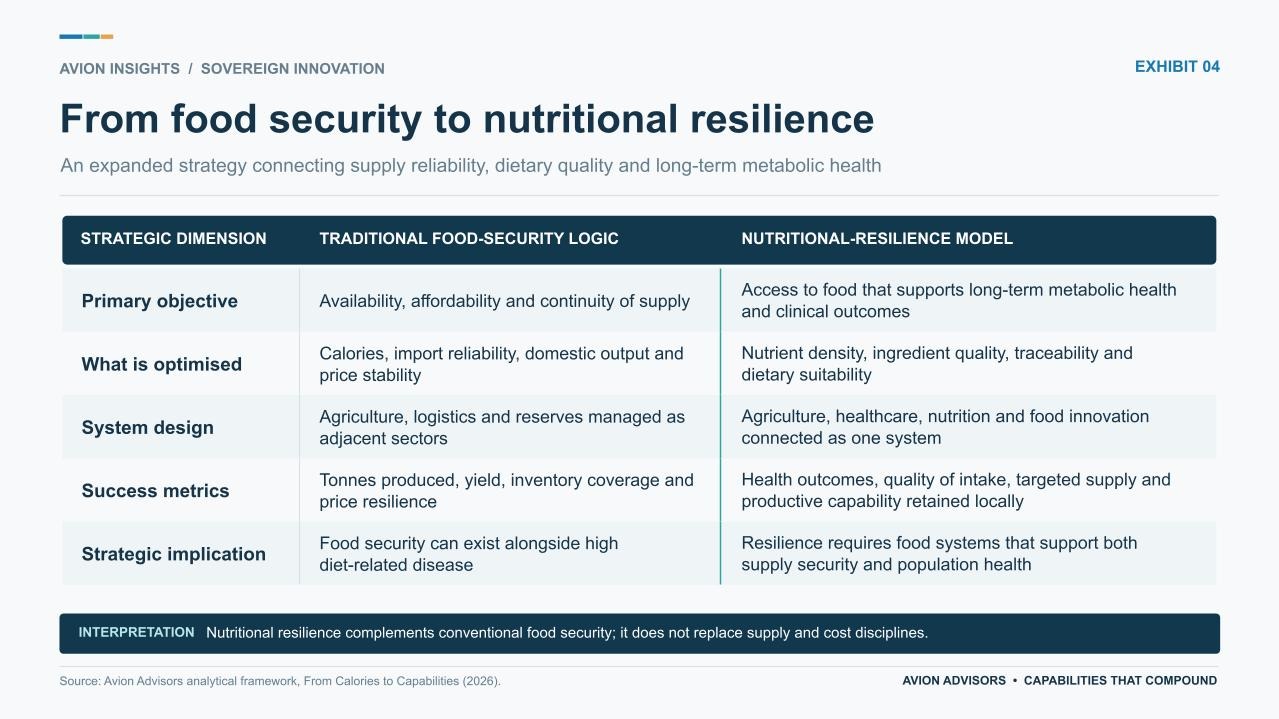
This does not require replacing existing food-security objectives. Rather, it calls for evaluating agricultural and food-system investments through an additional set of outcomes.
In water-constrained environments, agricultural productivity must continue to consider land utilisation, water efficiency, energy consumption and commercial viability. However, these indicators can be complemented by measures of nutritional contribution, ingredient quality, post-harvest preservation and the reliability of access to foods that support healthy dietary patterns.
The distinction is particularly relevant to controlled-environment agriculture, hydroponics, advanced greenhouses and food-processing technologies.
These systems can improve predictability, traceability and production consistency under challenging environmental conditions. They may also create opportunities to align production planning with institutional demand from hospitals, schools, healthcare providers and specialised nutrition businesses.
Nevertheless, local production should not become an end in itself.
Energy-intensive cultivation may not be economically or environmentally preferable to diversified imports for every food category. A sophisticated food-security strategy must therefore distinguish between products for which domestic production creates strategic value and those for which international sourcing remains more efficient.
The objective is not complete agricultural self-sufficiency. It is the development of sufficient productive capability, supply-chain flexibility and institutional knowledge to maintain resilient access to nutritious food.
This distinction becomes especially important as the relationship between medicine and nutrition evolves.
A patient receiving metabolic therapy may require carefully managed nutritional intake, while an older person facing muscle loss may have substantially different dietary requirements from an otherwise healthy adult. Such differences cannot be resolved through aggregate food-production targets alone.
They require food systems capable of greater precision.
The next generation of food-security policy may therefore need to consider not only how much food can be produced, but how effectively agricultural production, processing, distribution and consumption contribute to long-term health.
The Gulf's opportunity is not purely theoretical. Several developments in Abu Dhabi demonstrate how the foundations of a more integrated metabolic-health economy are beginning to emerge.
On October 20, 2026, Eli Lilly and an Abu Dhabi-based life-sciences company announced an agreement to localise the packaging and logistics of Lilly's GLP-1 medicines. The collaboration will be supported by pharmaceutical packaging and warehousing infrastructure at a 125,000-square-metre site in Khalifa Economic Zones Abu Dhabi, with implementation subject to technical, quality and regulatory requirements.[6]
The immediate significance lies in participation in a specialised global pharmaceutical supply chain. Localised packaging and distribution can support supply reliability, regulatory expertise, pharmaceutical logistics and the development of specialised industrial employment.
It is important, however, to distinguish these capabilities from domestic drug discovery or the manufacture of active pharmaceutical ingredients. The announced agreement concerns packaging and logistics rather than a complete transfer of pharmaceutical research or production technology.
This distinction is central to evaluating its longer-term economic significance.
An international pharmaceutical partnership creates greater strategic value when the initial activity becomes a platform for developing additional local capabilities in quality systems, process engineering, clinical research, specialised manufacturing and related services.
Abu Dhabi already has institutions that could support such progression.
The Health, Endurance, Longevity and Medicine (HELM) cluster, launched in 2025, focuses on advancing medical research, pharmaceutical innovation, biotechnology and digital healthcare. Its architecture brings together scientific institutions, healthcare providers, government agencies and industrial-development capabilities.[7]
Alongside it, the AgriFood Growth and Water Abundance (AGWA) cluster focuses on food and water technologies, including advanced agriculture, alternative proteins, functional ingredients and associated scientific and industrial capabilities.[8]
These clusters address different economic priorities, yet their potential complementarities become clearer when examined through metabolic health.
Scientific research can inform clinical nutrition requirements. Clinical evidence can inform food formulation and product development. Agricultural innovation can support the production of appropriate ingredients. Food-processing and logistics infrastructure can translate those ingredients into reliable consumer and institutional products.
The most valuable development may therefore occur at the interfaces between existing capabilities rather than through the creation of an entirely new institutional structure.
There is also an emerging clinical foundation.
On November 2, 2026, Abu Dhabi authorities reported that more than 6,500 individuals had benefited from the emirate's Personalised Weight Management Programme. Participants were reported to have achieved average weight loss of 14%, with reductions exceeding 22% among those who remained engaged for a full year. The programme operates across more than 54 healthcare facilities and combines medical interventions, nutritional counselling, behavioural support and continued follow-up.[9]
These programme-level results are encouraging, although they are not equivalent to a controlled clinical trial and cannot establish the independent effect of any particular medication or intervention.
Their broader significance lies in the operating model.
Rather than treating pharmaceutical access as an isolated transaction, the programme integrates medication with clinical oversight, behavioural support and ongoing patient management.
Such systems generate operational experience that may eventually support more sophisticated models of preventative healthcare, provided that clinical outcomes, long-term adherence and cost-effectiveness are rigorously evaluated.
The strategic opportunity is to connect these clinical capabilities with domestic research, food innovation and industrial development.
That would represent a progression from providing access to external innovation toward developing the capacity to adapt, integrate and improve it locally.
The convergence of pharmaceutical innovation, nutritional science, food technology and healthcare infrastructure suggests that the future competitive landscape will not be determined solely by which countries manufacture medicines or produce food.
It will also depend on which economies become effective at connecting scientific knowledge with clinical outcomes, consumer needs and industrial production.
This requires a different interpretation of competitive advantage.
Traditional industry strategies often attempt to improve the performance of individual sectors. Pharmaceutical programmes focus on research, manufacturing and access. Agricultural programmes focus on productivity and supply. Food manufacturers focus on product development, distribution and consumer demand. Healthcare providers focus on clinical effectiveness and service delivery.
An integrated metabolic-health system would preserve the specialisation of these sectors while improving their ability to exchange knowledge, coordinate activity and generate complementary value.
Exhibit 5 translates this systems argument into six economic layers, showing how conventional sector activities could progress toward capabilities that are harder to replicate and more likely to remain economically productive over time. The relevant measure is not the number of initiatives that fall within the metabolic-health theme, but the extent to which these activities generate reusable expertise, specialised suppliers, validated evidence and exportable products.
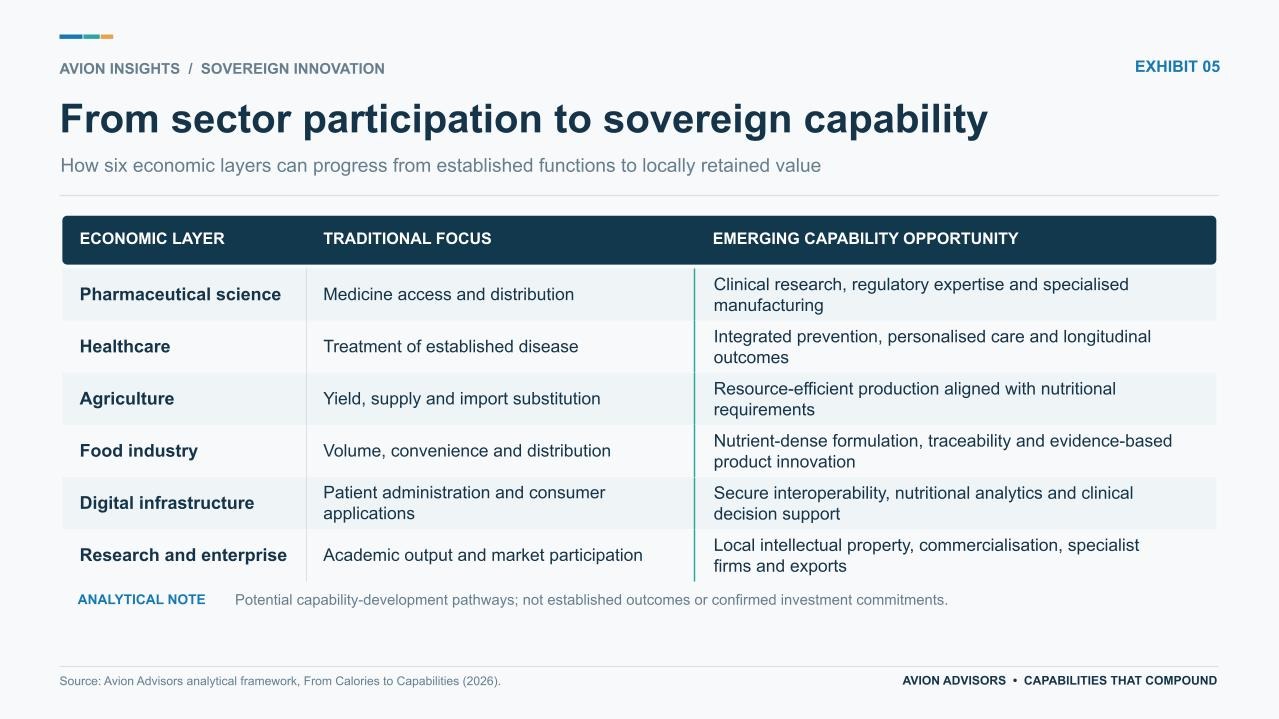
Exhibit 5 distinguishes the conventional contribution of each sector from the capabilities that coordinated investment could make possible. These prospective outcomes should not be confused with programmes that have already been implemented; the exhibit is an analytical framework for identifying where knowledge, skills and intellectual property might accumulate locally.
The distinguishing characteristic of this architecture is the movement of knowledge between sectors.
A clinical research programme may identify nutritional requirements associated with metabolic treatment. These findings can inform food-product development, which subsequently creates demand for particular ingredients, production methods and quality standards.
Agricultural enterprises may respond through improved cultivation techniques, while food manufacturers develop appropriate products and healthcare providers evaluate their effectiveness.
If successful, the resulting system does more than improve a single product or service. It creates reusable knowledge, commercial relationships, specialised employment and additional opportunities for innovation.
The same logic applies to pharmaceutical localisation.
Packaging and logistics operations can remain discrete commercial activities, or they can become entry points for developing regulatory, technical and operational expertise that enables progressively more sophisticated participation in international pharmaceutical value chains.
The difference is determined by whether capability accumulates locally.
This is the central distinction between economic participation and Sovereign Innovation.
Participation provides access to markets, products and investment. Sovereign capability expands the capacity of institutions and enterprises to originate solutions, make independent decisions, adapt to external change and develop future generations of technology.
A metabolic-health economy offers an unusually compelling environment for this progression because improvements in one sector can generate productive opportunities across several others.
The long-term advantage would not necessarily belong to the economy consuming the greatest volume of metabolic medicines. It could belong to the economy that converts medical advances into the most durable combination of scientific expertise, clinical infrastructure, nutritional innovation and globally competitive enterprises.
The economic potential of GLP-1 innovation should not obscure its limitations.
Pharmaceutical interventions remain dependent on clinical eligibility, affordability, appropriate prescribing, safety monitoring and long-term adherence. Adverse effects, treatment discontinuation and uncertainty surrounding some long-term outcomes complicate assumptions about sustained population-wide benefits.
Nutritional requirements also become more important when appetite is substantially reduced.
Guidance published in 2026 by the American Diabetes Association emphasises adequate nutritional intake, attention to protein and micronutrient deficiencies, and muscle-strengthening activities during obesity pharmacotherapy. These considerations reinforce the need for appropriately trained clinicians, dietitians and evidence-based support services.[10]
Such requirements create commercial opportunities, but they also establish a higher standard of responsibility for food and nutrition companies.
Not every product marketed as supportive of metabolic health will demonstrate a meaningful clinical benefit. Claims involving functional ingredients, nutritional supplementation and personalised diets require appropriate evidence, especially when products are intended for patients managing chronic conditions.
There are also significant questions of accessibility.
If advanced therapies and complementary nutritional services remain concentrated among higher-income groups, innovation could increase the quality of care for some populations without materially reducing the overall burden of disease.
Similarly, pharmaceutical localisation does not automatically eliminate dependence on foreign intellectual property, specialised inputs or international regulatory systems.
The objective should therefore not be to substitute one form of dependency for another.
A durable strategy must balance international access with the development of local scientific and industrial capability. It must also preserve the role of preventative interventions that do not depend on medication, including healthy food environments, physical activity, early screening and public-health education.
Data infrastructure introduces a further challenge. Integrated healthcare and nutritional services may create opportunities for better clinical research and decision support, but their legitimacy will depend on consent, privacy, cybersecurity, appropriate governance and the avoidance of discriminatory use.
These considerations are not peripheral to the economic model. They determine whether technological progress can become an enduring public and institutional asset.
The most important question for Gulf policymakers and investors is not how quickly a new metabolic-health industry can be established. It is what capabilities will remain after the first generation of investments has been deployed.
A pharmaceutical packaging facility can generate employment and industrial revenue. Its contribution to longer-term economic development becomes greater if it also produces experienced technical operators, qualified suppliers, regulatory expertise and the foundation for more advanced manufacturing.
An agricultural investment can strengthen food availability. Its contribution becomes more durable if it generates transferable production knowledge, resource-efficiency improvements, skilled agricultural enterprises and commercially competitive products.
A clinical programme can improve outcomes for participating patients. Its wider value increases if those outcomes produce validated research, better treatment protocols, interoperable systems and capabilities that other healthcare providers can adopt.
These distinctions suggest that the next phase of economic development should be evaluated through capability formation as well as investment volume.
For a Gulf metabolic-health economy, relevant indicators would include the quality and durability of clinical outcomes; access to evidence-based nutritional support; the development of locally originated food and pharmaceutical intellectual property; improvements in resource-efficient agricultural production; the growth of specialised enterprises; and the ability to generate export revenue from products, technologies and services.
The most sophisticated systems would also assess whether research and commercial experience circulate between institutions.
Does a clinical programme generate new scientific research? Does that research inform a commercially viable product? Can the resulting enterprise compete internationally? Does its success create additional technical talent, suppliers and investment opportunities?
These are the mechanisms through which individual initiatives become a regenerative economic system.
The Gulf possesses many of the enabling conditions: substantial capital, established international partnerships, sophisticated logistics infrastructure, growing research institutions and significant domestic demand.
However, enabling conditions do not automatically produce integrated capabilities.
The next stage requires institutional coordination, disciplined commercialisation, sustained research and clearer mechanisms through which scientific knowledge can move into independently competitive enterprises.
Abu Dhabi's existing healthcare and agrifood infrastructure provides one possible foundation. Other GCC economies offer complementary strengths in pharmaceutical development, food processing, healthcare systems, research and market access.
A regional approach could therefore be more effective than replicating the same industrial capabilities across every national market.
Such cooperation would not diminish sovereignty. Properly structured, it could increase the region's collective capacity to access international innovation while expanding the knowledge, production capabilities and economic options retained within the Gulf.
Lotte Bjerre Knudsen's warning to the food industry captures an important consequence of pharmaceutical innovation: advances in medical science can change consumer behaviour in ways that established industries were not designed to anticipate.
Eli Lilly's latest clinical developments suggest that this transformation may continue as more effective and accessible metabolic therapies emerge. The expansion of pharmaceutical capabilities in Abu Dhabi demonstrates that countries are already responding to the industrial implications of this emerging market.
Yet the more consequential opportunity lies beyond the medicines themselves.
The Gulf faces a long-term challenge in which metabolic disease, nutritional quality, healthcare expenditure, food security and industrial development are deeply interconnected. Addressing these issues independently risks creating sophisticated but fragmented systems.
Connecting them creates the possibility of a different economic outcome.
Pharmaceutical innovation can improve treatment. Nutritional science can strengthen the quality of care. Agricultural and food technologies can improve access to appropriate ingredients. Clinical research can generate evidence. Industrial investment can translate that evidence into products, enterprises and exportable expertise.
When these activities reinforce one another, they create a foundation for capabilities that extend beyond any individual medicine, manufacturer or agricultural technology.
The distinction is important because GLP-1 therapies will continue to evolve. New medicines will emerge, treatment economics will change, and consumer preferences may shift again. The companies that lead the pharmaceutical market today may not be the companies that define it a decade from now.
The need for resilient food systems, preventative healthcare, scientific expertise and high-quality nutrition will remain.
For the Gulf, the strategic opportunity is therefore not to build an economy dependent on the continued expansion of a single therapeutic category. It is to use the current period of pharmaceutical innovation to strengthen the broader systems that determine human health and economic resilience.
The next competitive advantage may belong not to the countries that consume the most innovation, but to those that turn innovation into capabilities their societies and enterprises can continue to develop, control and regenerate.
That is the opportunity emerging at the intersection of medicine, food and Sovereign Innovation.
[1] Eli Lilly and Company. Retatrutide Phase 3 TRANSCEND-T2D-2 topline results, October 28, 2026.
[2] Madhumita Murgia. Weight-loss drug pioneer Lotte Bjerre Knudsen: 'The food industry has to listen', Financial Times, October 30, 2026.
[3] Hristakeva, S., Liaukonytė, J., and Feler, L. The No-Hunger Games: How GLP-1 Medication Adoption Is Changing Consumer Food Demand, Journal of Marketing Research, 2026.
[4] World Health Organization. WHO issues global guideline on the use of GLP-1 medicines in treating obesity, December 2025.
[5] International Diabetes Federation. Diabetes Atlas, 11th edition—UAE country data and projections, 2025; 2024 estimates.
[6] Abu Dhabi Media Office. Pharmaceutical manufacturing and localisation agreement, October 20, 2026.
[7] Department of Health – Abu Dhabi. Launch of the Health, Endurance, Longevity and Medicine cluster, April 15, 2025.
[8] Abu Dhabi Investment Office. AgriFood Growth and Water Abundance cluster, official programme overview.
[9] Abu Dhabi Media Office. Personalised Weight Management Programme results, November 2, 2026.
[10] American Diabetes Association. Pharmacologic Treatment of Obesity in Adults: Standards of Care, 2026.
Avion Advisors | Sovereign Innovation. Capabilities That Compound.
This analysis distinguishes established clinical findings, preliminary trial announcements, observed consumer patterns and prospective industrial-development opportunities. Forward-looking interpretations represent strategic analysis rather than forecasts of clinical or commercial outcomes.