In July 2025, a New York restaurant known for its vegetable-forward menus opened its first Virginia location in Clarendon, just outside Washington, D.C. Westville, founded in Manhattan in 2003, had built its reputation around a deceptively simple proposition: vegetables should occupy the center of the American plate rather than its margins. Its signature market plate, featuring a rotating selection of up to 21 vegetable preparations, translated an emerging consumer preference into a successful neighborhood restaurant concept.
Its expansion into Northern Virginia illustrates an increasingly important characteristic of American food consumption. Demand for fresh, diverse, and nutritionally valuable food extends well beyond the metropolitan markets that initially popularized such offerings. Yet the agricultural economy supplying these consumers faces a paradox. While demand for vegetables and diversified food products creates new commercial opportunities, the land, capital, and infrastructure required to produce them are becoming increasingly constrained.
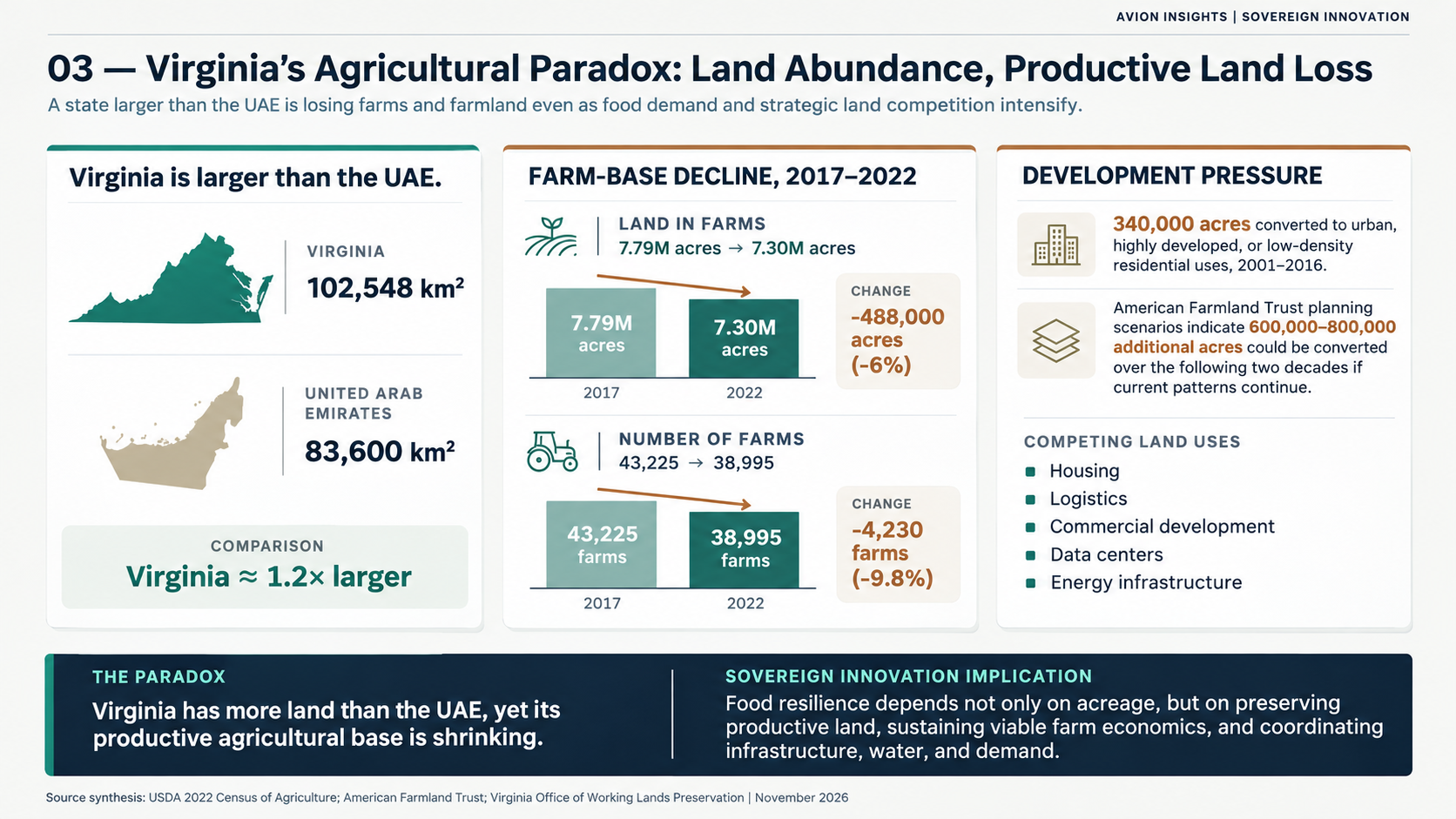
Virginia is particularly revealing. With approximately 102,000 square kilometers of land, it is geographically larger than the entire United Arab Emirates, whose reported area is approximately 83,600 square kilometers. Virginia possesses fertile soils, established agricultural communities, substantial freshwater resources, and direct access to one of the wealthiest consumer corridors in the United States. Nevertheless, the Commonwealth lost approximately 488,000 acres from its agricultural land base between 2017 and 2022, according to the U.S. Census of Agriculture. Over the same period, more than 4,000 farms disappeared from the state's agricultural census.
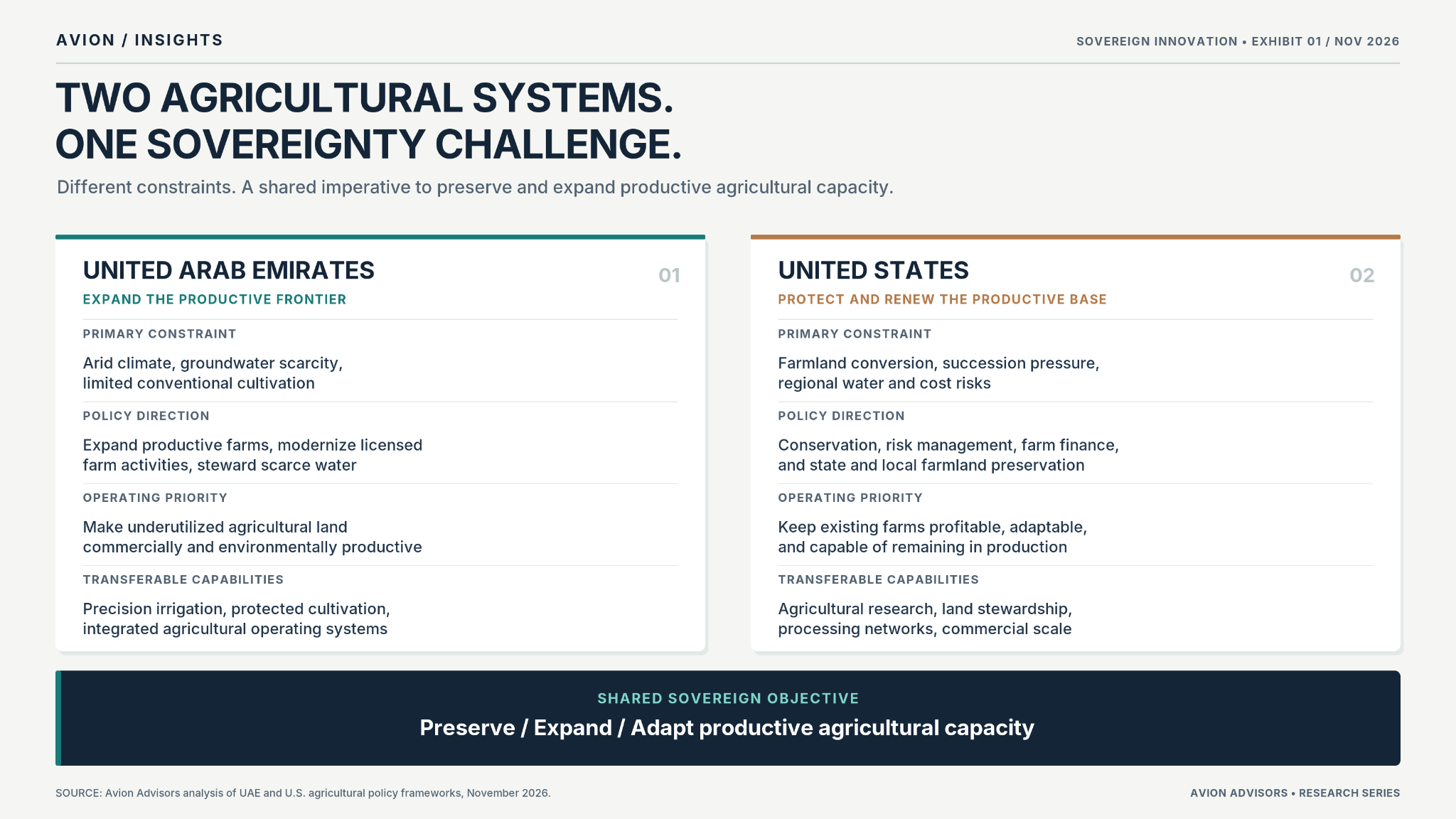
Thousands of kilometers away, the United Arab Emirates approaches the same fundamental challenge from the opposite direction. Its predominantly arid environment has historically limited conventional agricultural production, making international food trade indispensable to national provisioning. Yet the country's response has increasingly moved beyond securing imports toward deliberately expanding productive capacity through technology, institutional coordination, resource management, and agricultural policy.
The distinction matters. Virginia must prevent productive agricultural land from disappearing into competing uses. The UAE must make more of its land economically and environmentally capable of producing food. One is confronting the erosion of an established agricultural base; the other is seeking to enlarge its productive frontier.
Both are confronting the same strategic question: how does a nation retain the capacity to feed its population when the economic, environmental, and institutional foundations of food production can no longer be taken for granted?
For Avion Advisors, this is a question of sovereign innovation. The challenge is not simply how nations produce more food, but how they develop the institutional and technological capabilities to preserve, expand, and adapt the systems upon which their food security depends.
Food insecurity is frequently associated with environments where agricultural production appears naturally difficult: deserts, drought-prone regions, small island nations, or countries with limited freshwater access. This geographic framing is increasingly inadequate.
The United States remains one of the world's most significant agricultural producers and exporters. Its productive capabilities are supported by generations of agronomic research, advanced machinery, extensive logistics networks, agricultural universities, financial institutions, and integrated commodity markets. By conventional measures of agricultural scale, it possesses advantages that few nations can replicate.
Scale, however, is not synonymous with resilience.
According to the U.S. Department of Agriculture's February 2026 Farms and Land in Farms report, the number of American farms declined to approximately 1.865 million in 2025, compared with more than 2.02 million in 2018. Land classified as being in farms declined from approximately 899 million acres to 874 million acres over the same period. These figures describe changes in agricultural operations and land use, not exclusively permanent conversion to development. Nevertheless, they establish a persistent contraction in the country's agricultural operating base.
Meanwhile, the agricultural system faces additional pressures from rising land values, farm succession, energy and input costs, groundwater depletion, climate variability, and competition for land from housing, logistics, renewable energy installations, and digital infrastructure.
These pressures manifest differently across the country. Water scarcity and irrigation sustainability are central concerns in parts of the Southwest. Urban encroachment and industrial land conversion are particularly consequential in rapidly developing metropolitan corridors. Soil health, flooding, extreme weather, and aging farm ownership create different constraints across the Midwest, Southeast, and Northeast.
The result is that an agricultural superpower can possess substantial aggregate production while becoming increasingly exposed to localized failures of productive capacity.
The UAE provides an instructive counterpoint because it has never been able to regard natural agricultural abundance as a permanent entitlement. Water scarcity, high temperatures, saline soils, and dependence on imported commodities make the vulnerabilities of food systems unusually visible. They also create a powerful incentive to develop technologies that increase productive output from limited resources.
This is the first transferable insight from desert agriculture: scarcity forces systems innovation that abundance can postpone.
Precision irrigation, protected cultivation, crop-environment monitoring, water reuse, agricultural automation, and climate-adaptive production are not exclusively desert technologies. They are responses to resource constraints that increasingly affect agricultural regions far beyond the desert.
Their relevance to the United States therefore extends beyond Arizona, Nevada, or California. They can inform the future of agricultural production in Virginia, Pennsylvania, Georgia, the Carolinas, and other regions where land, labor, water, profitability, and environmental conditions are becoming more difficult to reconcile.
The United Arab Emirates' contemporary food security agenda is often understood through the narrow lens of import dependence. This interpretation understates the direction of its institutional reforms.
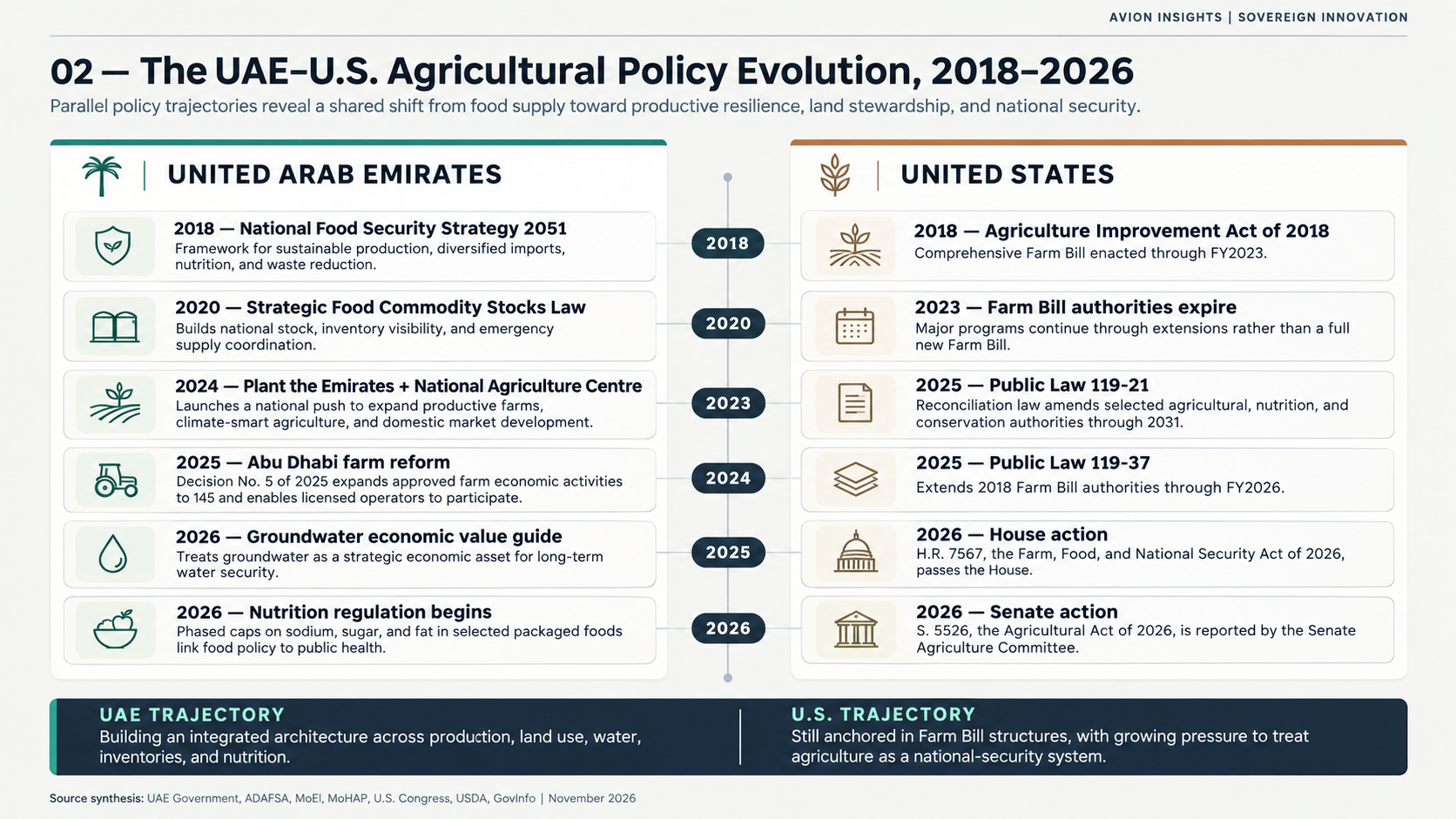
The UAE's National Food Security Strategy 2051 establishes a broader framework encompassing sustainable domestic production, diversified trade relationships, alternative supply arrangements, food safety, nutrition, and waste reduction. Its national food basket identifies 18 major categories based on consumption, production capacity, processing, and nutritional requirements.
Importantly, the strategy does not imply that international trade should be replaced by domestic production. Geographic conditions make complete agricultural self-sufficiency neither an obvious economic objective nor an environmentally desirable one. Rather, its strategic logic is to preserve access to global markets while increasing the country's ability to produce, manage, and distribute essential food within its own territory.
This distinction lies at the center of sovereign innovation. Sovereignty does not require independence from every international supplier. It requires sufficient domestic capability, diversified relationships, and institutional control to prevent dependence from becoming structural vulnerability.
The UAE has begun translating this distinction into a series of policy and regulatory interventions.
In October 2024, the UAE Cabinet introduced the Plant the Emirates national programme and approved the establishment of the National Agriculture Centre. The initiative linked agricultural production to technological development, private-sector participation, domestic marketing, and a broader national culture of cultivation.
The Centre's announced 2025–2030 objectives include increasing the number of productive farms by 20%, expanding organic farms by 25%, supporting climate-smart solutions across 30% of farms, reducing agricultural waste by 50%, and increasing the use of locally produced agricultural products in restaurants and hotels by 25%.
These are policy targets rather than completed outcomes, but their construction is significant. Production, environmental efficiency, market access, and private-sector adoption are being treated as related components of agricultural transformation.
The emphasis on restaurants and hotels is particularly instructive. Agricultural production cannot develop into a durable industry if farms lack sufficiently predictable buyers. By linking agricultural development to domestic commercial consumption, the policy begins addressing demand formation alongside supply expansion.
The implication is that agricultural modernization requires more than improving how crops are grown. It requires developing the commercial conditions under which cultivation becomes economically viable.
A particularly consequential development occurred in September 2025, when Abu Dhabi's Agriculture and Food Safety Authority announced Decision No. 5 of 2025, amending Decision No. 3 of 2023 on economic activities conducted on farms.
The amendment authorized 74 additional farm-based economic activities, bringing the total number of permitted activities to 145. The expanded framework covers plant production, agricultural support services, food-related services, industrial support, and other complementary activities.
More consequentially, it permits appropriately licensed establishments in Abu Dhabi, rather than only the farm's owner, to seek authorization to conduct approved economic activities on agricultural properties. Landowners may also lease farms to licensed establishments for permitted activities.
The regulatory conditions remain material. Farms must continue to be used for their designated purposes, and construction undertaken for economic activities must remain within applicable limits established by the competent authorities. The reform should therefore not be interpreted as unrestricted commercialization or automatic permission for every industrial use.
Nevertheless, its economic implications are substantial.
Historically, agricultural land may remain underproductive because ownership, operating expertise, and investment capital reside with different parties. A landowner may possess an agricultural asset without the capacity or incentive to finance advanced cultivation systems. An agricultural technology operator may possess the necessary expertise but lack access to appropriately situated land. Institutional investors may be willing to finance agricultural infrastructure but be reluctant to acquire fragmented property holdings.
A regulatory framework that permits licensed third-party agricultural activity can help connect these complementary resources while preserving land ownership.
This creates the possibility of agricultural operating models in which land, productive infrastructure, technology, and commercial distribution are coordinated without requiring all the underlying assets to be owned by the same institution.
For a nation seeking to expand agricultural capacity, the distinction between owning farmland and making farmland productive is critical.
The Emirates' agricultural reforms also recognize that expanding production without accounting for water scarcity could produce a different form of national vulnerability.
In January 2026, the Ministry of Energy and Infrastructure launched the National Guide of the UAE Groundwater Economic Value. The guide proposes an analytical framework for evaluating groundwater abstraction, water quality, operating costs, soil characteristics, alternative water sources, and the consequences of depletion.
Although the guide is not itself a blanket prohibition on groundwater extraction, it reflects an important change in policy reasoning: water must be evaluated as a scarce economic asset whose use creates consequences beyond the individual farm.
This has direct implications for agricultural investment. A production system that generates high crop yields but depends on unsustainable groundwater extraction may improve short-term food supply while weakening long-term national resilience.
Conversely, systems capable of increasing edible output while reducing freshwater consumption can create economic value beyond the farm's immediate revenue.
Protected cultivation, precision fertigation, soil and substrate monitoring, recycled water systems, and careful crop selection become instruments of natural-resource stewardship as well as agricultural productivity.
The necessary evaluation is therefore not simply yield per hectare, but the relationship among yield, water consumption, energy requirements, operating margins, and long-term resource sustainability.
The regulatory framework extends further. Federal Law No. 3 of 2020, regulating strategic food commodity stocks, establishes obligations concerning inventory availability, storage, information sharing, and emergency distribution. Its provisions include electronic connectivity between registered market participants and competent authorities for monitoring the quantities and condition of strategic commodities.
Federal Law No. 10 of 2015 on Food Safety provides a framework for managing food-related risks across the supply chain. More recently, Federal Law No. 7 of 2025 on Agricultural Quarantine modernized plant-health protections, including phytosanitary controls, pest surveillance, inspections, and the movement of agricultural consignments. The updated legislation was accompanied by reforms concerning veterinary quarantine and the protection of new plant varieties.
Taken together, these instruments recognize that food security depends not only on cultivation, but also on the protection of agricultural biological resources, inventory visibility, and the integrity of food supply chains.
An additional dimension emerged in October 2026, when the Ministry of Health and Prevention began implementing a national resolution establishing phased limits on sodium, sugar, and fat content in specified categories of packaged foods, with final compliance milestones extending to December 2030.
The measure applies to targeted product categories, including certain breads, sweetened dairy products, snacks, and processed cheeses, rather than to all foods indiscriminately. Its significance lies in the extension of food policy beyond the quantity and safety of food toward its nutritional composition.
This creates a connection between agricultural production, food manufacturing, public health, and domestic market development.
The policy question is no longer merely whether sufficient food can be supplied. It is also whether national agricultural and food-processing systems can support healthier consumption over time.
For agricultural producers, this may create opportunities to supply ingredients and crops aligned with changing nutritional requirements. For institutional purchasers serving schools, hospitals, and other public facilities, it provides a reason to consider agricultural procurement within broader public-health objectives.
The UAE's emerging policy architecture therefore links four dimensions that are too often treated separately: agricultural production, natural-resource security, commercial market formation, and nutritional outcomes.
The United States approaches agricultural security through a considerably older and more complex institutional architecture.
Federal agricultural policy has evolved through successive Farm Bills beginning in the twentieth century. These laws provide the foundation for an extensive range of activities, including commodity support, crop insurance, conservation, farm credit, rural development, agricultural research, nutrition assistance, and international trade.
The Agriculture Improvement Act of 2018 remains the most recently enacted comprehensive Farm Bill. Its principal authorities expired in 2023 and were extended through successive legislative measures. A further extension enacted in November 2025 covered fiscal year 2026, while the 2025 budget reconciliation law, Public Law 119-21, separately amended and reauthorized selected agricultural programs through 2031.
As of November 2026, Congress has advanced but not completed a comprehensive replacement. The House passed the Farm, Food, and National Security Act of 2026, H.R. 7567, on April 30. The Senate Agriculture Committee reported the Agriculture Act of 2026, S. 5526, in September. The two versions differ across several policy areas and remain subject to further legislative action.
The distinction between enacted authorities and proposed legislation matters. Congressional consideration of a new Farm Bill signals policy priorities, but its provisions do not become operative simply because one chamber or committee has approved them.
The more fundamental issue, however, lies in what agricultural policy has historically been designed to achieve.
The American agricultural policy system has developed significant mechanisms for protecting producers against price volatility, natural disasters, and production risks.
Agriculture Risk Coverage and Price Loss Coverage provide support for eligible commodities under specified market conditions. Federal crop insurance allows participating producers to manage certain yield and revenue risks. USDA conservation programs support eligible investments in soil, water, environmental stewardship, and agricultural land protection.
These instruments serve legitimate public purposes. Agricultural volatility can threaten farmer livelihoods, disrupt credit markets, and undermine production continuity. A functioning risk-management system is therefore essential to national food security.
Yet the structure of agricultural support may also influence which crops are grown, how capital is allocated, and how producers evaluate the risks of changing their operations.
For farmers considering higher-value vegetables, diversified crop rotations, alternative production methods, or new institutional supply chains, the principal obstacle may not be agricultural knowledge. It may be the absence of buyers, specialized infrastructure, suitable insurance coverage, transition capital, or reliable distribution channels.
A farmer can be technically capable of producing a nutritious crop and still lack a commercially viable reason to grow it.
This creates a policy challenge that cannot be resolved through production incentives alone. Agricultural resilience requires aligning demand, land access, investment, technology, and risk management so that farmers can change their production models without assuming disproportionate financial exposure.
The relevant measure of success must therefore extend beyond physical yield. Risk-adjusted profitability, income stability, resource efficiency, and access to durable markets become equally important.
The United States already possesses substantial policy instruments for land and resource conservation.
The Environmental Quality Incentives Program supports eligible conservation practices. The Conservation Stewardship Program rewards qualifying stewardship activities. The Agricultural Conservation Easement Program can help protect agricultural land through conservation easements. The Regional Conservation Partnership Program coordinates conservation initiatives among multiple stakeholders.
The 2025 budget reconciliation legislation extended and modified important conservation authorities, with several major programs authorized through fiscal year 2031.
These programs are essential, but they operate within a fragmented institutional environment. Federal agricultural incentives do not independently determine how every parcel of privately owned land is zoned, valued, inherited, financed, or converted to another use.
In much of the United States, including Virginia, consequential land-use decisions are made at the state and local levels.
The federal government can support conservation, but it cannot ensure agricultural continuity if local development economics consistently reward conversion or if a farm cannot earn sufficient income to remain viable.
This illustrates a distinction between protecting agricultural land as a physical resource and preserving agriculture as a functioning economic system.
Conservation easements may prevent development. They do not automatically create profitable farming operations, available labor, functioning cold chains, or reliable demand for local agricultural products.
Both forms of capacity are necessary.
The proposed 2026 Farm Bills retain the wide-ranging architecture of American agricultural policy while introducing modifications across commodity programs, conservation, nutrition, financing, research, specialty crops, and crop insurance.
Both House and Senate proposals would extend specialty-crop block-grant authorities and agricultural research programs. They also contain measures concerning conservation, agricultural credit, and national security.
Of particular interest, the national security provisions address foreign ownership of agricultural land and related disclosure and oversight mechanisms.
These measures reflect a growing recognition that farmland is a strategic national asset.
Ownership transparency and protection against hostile control can be important components of national security. Yet ownership restrictions alone cannot prevent productive acreage from becoming uneconomic, losing its water supply, or being converted to uses that permanently diminish domestic food-production capacity.
The more comprehensive question is whether American agricultural policy can incorporate productive capacity itself as a measurable national strategic interest.
Such an approach would build upon existing federal conservation and farm-support systems rather than assume they should be discarded. It would connect them more deliberately to land-use planning, food-sector demand, processing infrastructure, nutritional goals, and commercially viable agricultural innovation.
Virginia demonstrates why a country does not need to be predominantly arid to face serious threats to its food-production system.
According to the USDA's 2022 Census of Agriculture, Virginia contained 38,995 farms operating approximately 7.3 million acres. Roughly 95% of farms were family-owned and operated. The state's agricultural land base declined by approximately 6% between 2017 and 2022, while the number of farms fell by nearly 10%.
These statistics should be interpreted carefully. A decline in census-defined land in farms does not establish that every lost acre was permanently paved or developed. Land can leave agricultural classification through multiple forms of ownership, operating, and land-use change.
Nevertheless, independent land-conversion evidence confirms the scale of development pressure. The American Farmland Trust's Virginia planning research identifies approximately 340,000 acres converted to urban, highly developed, or low-density residential uses between 2001 and 2016. Much of this conversion resulted from dispersed, low-density development, which can fragment the agricultural landscape even before surrounding farms cease operation.
The organization's planning toolkit also identifies scenarios in which a further 600,000–800,000 acres could be converted over the following two decades if existing development pressures are not adequately managed. These figures are projections, not inevitable outcomes.
Virginia thus faces a double challenge. Agricultural land is increasingly valuable for nonagricultural purposes, while agricultural enterprises themselves must remain economically attractive to succeeding generations.
This is particularly apparent in Northern Virginia, where housing, commercial development, logistics, and data-center infrastructure compete for land and resources.
The emergence of the region as a major digital infrastructure corridor creates significant economic opportunities. Data centers support cloud computing, artificial intelligence, and broader national technological competitiveness. These are important strategic assets in their own right.
The policy challenge is not to treat digital infrastructure and agriculture as inherently incompatible. It is to recognize that both require scarce physical resources and that their development cannot be optimized independently.
In April 2026, Virginia enacted a measure concerning the siting of high-energy-use facilities, including certain data centers expected to require 100 megawatts or more of electrical power. The legislation requires specified local assessments of noise and utility infrastructure and allows localities to request assessments covering agricultural resources, groundwater, surface water, forestland, and other environmental considerations.
This is a constructive recognition of infrastructure externalities. Yet it also illustrates why agricultural preservation must be deliberately included in planning decisions: assessment of agricultural impacts is permitted under the measure, but it is not uniformly mandatory in the same way as its specified noise assessment.
Virginia possesses additional tools, including agricultural and forestal districts, use-value taxation, conservation easements, and purchase-of-development-rights programs. Its Office of Working Lands Preservation is another institutional mechanism supporting farm and forestland conservation.
The challenge is to integrate these protections into a broader economic strategy that rewards productive agricultural use.
A field preserved from development but deprived of commercially viable farming opportunities is not equivalent to a functioning agricultural enterprise. Conversely, an economically productive farm without durable land protection remains vulnerable to future conversion.
The two policy objectives must reinforce one another.
The expansion of vegetable-forward food concepts such as Westville provides a useful illustration of changing food-market opportunities, although an individual restaurant opening should not be mistaken for definitive evidence of aggregate consumer demand.
Virginia has access to significant demand from households, restaurants, schools, universities, hospitals, food manufacturers, and other institutional purchasers.
Yet consumer demand does not automatically translate into local agricultural production. A restaurant may source produce through regional or national distribution networks because local growers cannot consistently meet its requirements for volume, price, quality, packaging, or delivery.
A school may wish to procure more nutritious food, yet lack a purchasing mechanism that enables nearby farms to supply its kitchens reliably.
A farmer may be interested in diversifying production, yet lack the financing needed to establish protected cultivation, irrigation upgrades, specialized harvesting systems, or post-harvest infrastructure.
These are not isolated failures of agricultural productivity. They are coordination failures across the food system.
The opportunity, therefore, is not merely to save farmland or expand local consumption independently. It is to create commercially functional relationships between the agricultural resources that remain and the markets that could sustain them.
The conventional narrative of agricultural technology transfer assumes that innovation originates in countries with mature agricultural industries and subsequently diffuses into regions with more difficult production environments.
The UAE's emerging agricultural strategy suggests that this relationship can become increasingly bilateral.
Desert environments provide demanding conditions for testing technologies designed to operate under water scarcity, temperature extremes, soil limitations, and high resource costs. Innovations that perform reliably under such constraints may offer commercially valuable applications in other regions confronting related, though not identical, conditions.
The critical insight is that the most transferable innovation may not be a particular greenhouse design, irrigation device, or crop variety. It may be the architecture through which agricultural production is coordinated and continually improved.
A new generation of agricultural operating systems can connect sensors, environmental monitoring, irrigation control, crop selection, logistics, procurement, and financial performance within a common operational framework.
In such a system, field-level measurements can inform decisions about crop scheduling, water allocation, harvesting, maintenance, and distribution. Predictive analytics can help identify emerging production risks before they result in crop losses. Procurement information can influence planting decisions, while agricultural performance data can support more informed financing and insurance.
The objective is not to replace farmers with technology. It is to reduce the uncertainty and coordination costs that prevent agricultural expertise from translating into consistent economic returns.
These capabilities can be developed for protected cultivation in the Emirates and adapted to open-field agriculture, orchard management, peri-urban farming, or mixed production systems in the United States.
Transferability, however, should not be confused with universal technical suitability.
Highly controlled agricultural environments can reduce certain weather and water risks but may require substantial capital and electricity. Their economics can be favorable for some high-value perishable crops and unfavorable for lower-margin commodities. Greenhouses may be appropriate in one region, while precision irrigation, soil restoration, improved forecasting, or modest protective structures provide better returns elsewhere.
Agricultural innovation must be assessed through the entire production system rather than through technological sophistication alone.
A rigorous evaluation should consider risk-adjusted operating profit, crop-specific output, freshwater use, energy requirements, labor productivity, nutritional value, spoilage, and the reliability of supply. Environmental benefits must be measured against the full costs and resource requirements of the intervention.
For Virginia, the most valuable desert-derived innovation may be a system that allows an established farm to diversify into higher-value crops with less water waste, more predictable sales, and improved financial visibility.
For the UAE, the same underlying system may enable an underutilized agricultural property to become a productive operation despite difficult climatic conditions.
The technology differs in application; the sovereign capability being developed is the same.
It is the capacity to coordinate scarce resources into reliable domestic production.
The strategic relationship between the United States and the United Arab Emirates provides an unusually strong foundation for this form of cooperation.
In 2025, the UAE remained the largest destination for U.S. exports in the Middle East and North Africa for the seventeenth consecutive year. According to figures published by the UAE Embassy in Washington, bilateral trade reached approximately $39 billion, while U.S. exports to the Emirates totaled $31.4 billion. The United States recorded a trade surplus of approximately $23.8 billion.
The economic relationship extends far beyond commerce. Emirati investments in the United States exceed $1 trillion according to the UAE Embassy, while the two governments announced a ten-year, $1.4 trillion investment framework in 2025. The framework represents investment commitments and intended activity, not an assertion that the entire amount has already been deployed.
Cooperation spans artificial intelligence, semiconductors, energy, advanced manufacturing, aerospace, infrastructure, and financial services.
These relationships reflect an important evolution in the UAE's international position. The country is no longer adequately characterized as a destination that primarily imports technologies developed elsewhere. Its institutions increasingly participate in financing, developing, deploying, and commercializing technologies alongside international partners.
Agriculture offers an opportunity to extend this relationship into another strategically important sector.
The United States possesses extensive agricultural research capabilities, established farming expertise, large consumer markets, and sophisticated financial institutions. The UAE contributes its own strengths in infrastructure development, long-term capital formation, technology adoption, international logistics, and the integration of government strategy with commercial investment.
These advantages are complementary.
A bilateral agricultural innovation partnership need not begin with an expansive national treaty or a single flagship project. It could develop through coordinated demonstration environments in which universities, agricultural operators, technology companies, landowners, institutional buyers, and investors collaborate on commercially relevant production challenges.
Virginia and Abu Dhabi could offer particularly useful complementary test environments.
A system developed to reduce water consumption and improve crop visibility under arid conditions could be tested against the economics of diversification on Virginia farms. A Virginia-developed approach to soil conservation, cooperative distribution, or specialty-crop commercialization could be adapted to the UAE's operating environment.
Shared research methods, interoperable agricultural data standards, technical exchange, and carefully structured commercial partnerships could allow both systems to improve through repeated application.
Success would not be measured by the number of pilot announcements or memoranda signed. It would be measured by demonstrable improvements in water productivity, farm profitability, agricultural continuity, nutritional supply, and the commercial viability of new production systems.
This would represent a more mature form of bilateral innovation: two countries using their different constraints and comparative advantages to develop capabilities that neither could optimize as effectively in isolation.
A central premise of Avion Advisors' sovereign innovation thesis is that national resilience emerges from the ability to create and adapt capabilities that compound over time.
Agriculture provides a particularly tangible expression of this principle.
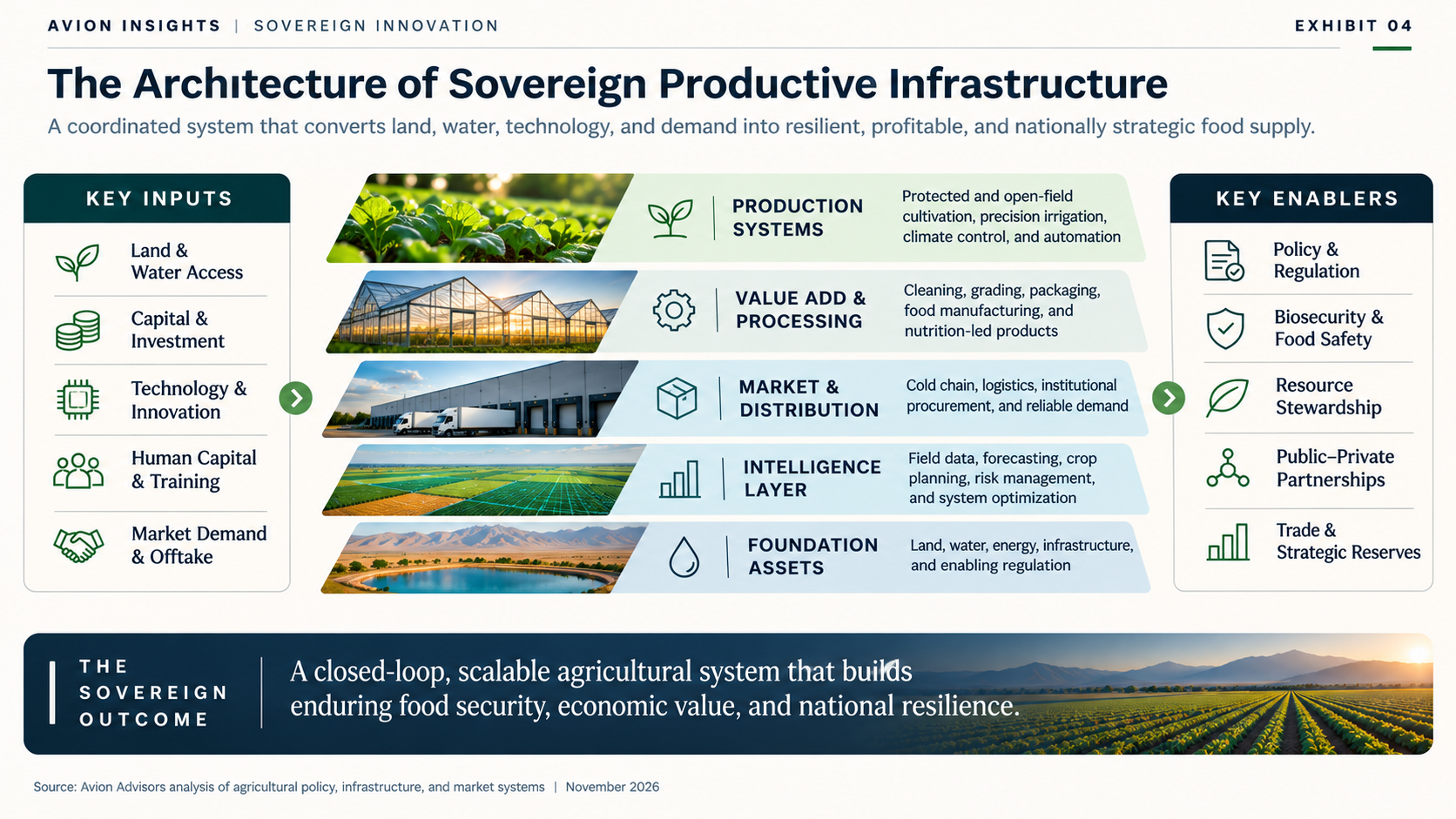
A farm is not an isolated productive asset. Its long-term viability depends on water access, energy, transport, financing, technical knowledge, crop inputs, regulatory permissions, labor, and demand.
When these elements operate independently, investment can become fragmented and innovation difficult to scale. When they are coordinated through shared infrastructure and durable commercial relationships, agricultural capacity can improve across multiple farms and markets.
This suggests a conceptual shift from viewing agriculture primarily as a collection of individual landholdings toward viewing it as a system of sovereign productive infrastructure.
Such infrastructure may include physical assets, such as irrigation networks, protected growing facilities, aggregation centers, cold storage, and processing capacity. It also includes less visible capabilities: operating software, agronomic data, standardized procurement interfaces, quality assurance, technical training, financing structures, and institutional coordination.
The value of these capabilities can compound.
Shared post-harvest infrastructure can reduce losses across multiple producers. Better demand forecasting can lower inventory risk for institutional buyers. Standardized crop information can improve traceability and planning. Reliable purchase agreements can support financing, while financing can enable investments that reduce production costs and improve crop quality.
Each improvement can reinforce the economic viability of the others.
This approach also changes how productive agricultural land should be valued.
A conventional land valuation may emphasize location, comparable sales, zoning, or alternative development potential. An agricultural systems perspective must also consider the land's productive capability, water requirements, access to infrastructure, proximity to buyers, and potential contribution to local and national food resilience.
The most strategically valuable land may not always be the land with the highest agricultural yield today. It may be the land that can support reliable and economically viable production under future environmental and market conditions.
That distinction is relevant in both countries.
In the UAE, an underutilized farm can become strategically valuable when infrastructure, advanced cultivation, and reliable buyers make it commercially productive.
In the United States, an existing farm can become more resilient when technology, protected land tenure, diversified crops, and integrated distribution improve its capacity to remain economically viable.
In both cases, the objective is to increase the productive options available to future generations.
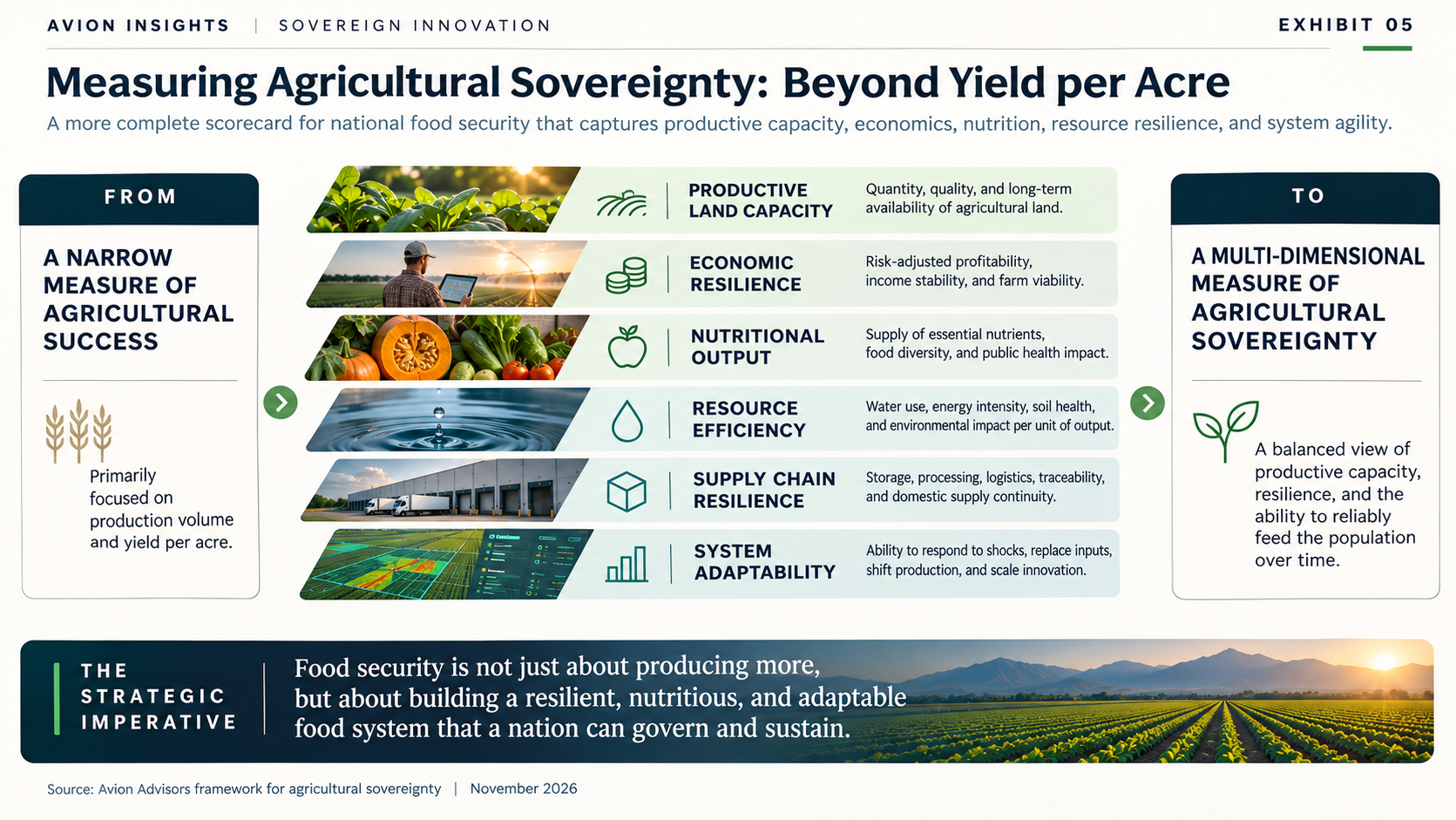
If food security is to be treated as national security, the way nations measure agricultural success must evolve accordingly.
Aggregate agricultural output remains important, but it cannot independently capture the resilience of a food system. A country may produce substantial quantities of agricultural commodities while remaining heavily dependent on imports for certain nutritional categories, processing inputs, or food products.
Similarly, farmland protection statistics do not necessarily capture whether protected land can generate sufficient income to remain operational.
A more comprehensive agricultural scorecard would measure multiple forms of productive capacity.
First, governments need to understand the quantity and quality of land that remains capable of agricultural production. This includes identifying permanent conversion, degraded land, changes in farm operation, groundwater constraints, and the infrastructure required to sustain productive use. Not every hectare carries the same agricultural potential, and not every acre classified as farmland provides the same contribution to food supply.
Second, economic performance must be evaluated alongside physical output. Risk-adjusted profitability, stable operating income, capital requirements, and access to markets determine whether producers can continue farming and reinvest in their operations. A production model that delivers impressive yields but consistently weak financial outcomes is not a durable foundation for national food security.
Third, nutritional production should become a more explicit consideration in agricultural planning. Calories, protein, essential micronutrients, and dietary diversity are not interchangeable measures. Crop selection and institutional procurement can be better informed by the nutritional requirements of the populations being served, while retaining flexibility for local diets, agronomic suitability, and economic conditions.
Fourth, natural-resource consumption must be incorporated into agricultural performance. Freshwater depletion, energy demand, soil health, salinity, and climate exposure influence whether output can be sustained. Improvements in crop yield are strategically meaningful only when evaluated against the resources required to achieve them.
Finally, resilience should be assessed at the level of the operating system. The ability to respond to supply disruptions, replace inputs, redirect distribution, maintain essential crop production, and adapt to new environmental conditions is as important as performance under normal market conditions.
These dimensions should not be reduced to a single national self-sufficiency target. Such targets may encourage inefficient domestic production of commodities better supplied through diversified international trade.
Instead, policymakers should identify which forms of domestic capacity provide the greatest strategic value and how those capabilities can complement reliable international supply relationships.
The convergence of American and Emirati agricultural challenges creates an opportunity to establish a new model of international food-security cooperation.
Rather than treating agricultural development as the transfer of equipment from one market to another, the two countries can focus on building interoperable capabilities: research, production infrastructure, procurement, financing, resource monitoring, and market intelligence.
Such cooperation would require public institutions to create enabling conditions while allowing farmers, entrepreneurs, research organizations, and private investors to determine which technologies and commercial models are viable.
For the UAE, this means continuing to translate its regulatory reforms and national objectives into productive agricultural enterprises capable of sustaining commercial demand without imposing excessive costs on water, energy, or public finances.
For the United States, it means strengthening the economic foundations of farming while preserving the land and natural resources upon which production depends. Federal policy can support this objective, but state governments, local planning authorities, financial institutions, and institutional food buyers must also participate.
The most promising commercial models are likely to integrate these functions rather than address them separately. A farmer with access to modern cultivation technology but no reliable buyer remains exposed. A buyer with predictable demand but no coordinated local supply network may continue relying on distant distribution systems. An investor with capital but insufficient operational data may struggle to finance agricultural infrastructure on commercially reasonable terms.
The strategic opportunity lies in connecting these participants through systems capable of reducing risk and improving economic performance throughout the value chain.
Over time, such systems could become transferable across regions with very different agricultural conditions.
An operating model established under the water constraints of Al Ain could inform production in water-stressed American regions. An institutional food-procurement model developed in Virginia could support agricultural commercialization in other states or countries. Innovations in traceability, forecasting, agricultural finance, and distributed infrastructure could improve the performance of both systems.
This is not a proposition that every country should replicate the UAE's agricultural methods. It is a proposition that countries should be able to adapt proven capabilities to their own resource conditions, commercial structures, and policy objectives.
The UAE's relatively small geographic scale may even become an advantage in developing and validating integrated operating models. Coordinated institutions and concentrated infrastructure can create opportunities to test systems before they are adapted to larger, more decentralized markets.
The ultimate value of these systems would lie not in their place of origin, but in their capacity to improve production and resilience wherever they are deployed.
The United States and the United Arab Emirates have developed one of the most significant economic relationships between an American global partner and a Gulf nation. Their cooperation has evolved from commerce and investment into joint participation in industries that will define the technological and industrial landscape of the coming decades.
Food security deserves an equivalent level of strategic attention.
For the United States, the challenge is not the absence of agricultural expertise or productive land. It is the risk that existing capabilities will be progressively weakened by land conversion, unfavorable farm economics, resource degradation, and the fragmentation of agricultural markets.
For the UAE, the challenge is not simply the physical presence of desert. It is how to convert limited natural resources, advanced technological capabilities, and institutional ambition into sustainable agricultural production without creating new forms of environmental or economic dependence.
These challenges are not identical, and their solutions should not be either.
Yet they share an underlying reality: productive capacity cannot be assumed merely because land exists, food is available for purchase, or technology has been developed somewhere in the world.
It must be continually created, protected, financed, and adapted.
A country rich in fertile land can lose agricultural sovereignty if it allows the institutions and economics supporting production to erode. A country with difficult natural conditions can strengthen its agricultural sovereignty by developing systems that expand its productive options.
The desert is therefore not an exception to the global food-security challenge. It is one of its most revealing environments.
For Avion Advisors, this is the deeper meaning of sovereign innovation: sovereignty is not defined by isolation, territorial abundance, or the ownership of technology alone. It is built through the sustained ability to convert knowledge, resources, institutions, and partnerships into capabilities that a nation can govern and adapt.
The next generation of agricultural resilience will be determined not simply by which nations possess the most farmland, but by which nations are best able to preserve and improve the productive systems that farmland supports.
Food security is national security. And the ability to build productive capacity—whether in the desert or on the world's most fertile land—is an increasingly important expression of sovereignty.
This analysis draws upon the following primary institutional sources and supporting case-study reporting:
United Arab Emirates: UAE Government, National Food Security Strategy 2051; UAE Cabinet, Plant the Emirates and National Agriculture Centre announcement (October 2024); Abu Dhabi Agriculture and Food Safety Authority, Decision No. 5 of 2025; Federal Law No. 10 of 2015 concerning Food Safety; Federal Law No. 3 of 2020 regulating Strategic Food Commodity Stocks; Federal Law No. 7 of 2025 concerning Agricultural Quarantine; Ministry of Energy and Infrastructure, National Guide of the UAE Groundwater Economic Value (January 2026); Ministry of Health and Prevention, implementation of nutritional composition limits (October 2026).
United States: USDA National Agricultural Statistics Service, 2022 Census of Agriculture and Farms and Land in Farms: 2025 Summary (February 2026); Agriculture Improvement Act of 2018; Public Law 119-21 (2025); Congressional Research Service, The 2026 Farm Bill: Comparison of the House-Passed and Senate Committee-Reported Bills with Current Law (November 10, 2026); USDA Natural Resources Conservation Service, Farm Bill conservation program guidance.
Virginia: USDA, 2022 Census of Agriculture—Virginia State Profile; Virginia Department of Agriculture and Consumer Services, Agriculture Facts and Figures; American Farmland Trust, Planning for Agriculture in Virginia; Virginia Office of Working Lands Preservation, Annual Report (December 2025); Virginia Acts of Assembly, Chapter 567 (April 2026); Capital Region Land Conservancy, Virginia Is Losing Farmland at a Record Pace (2024); WVTF/Radio IQ, reporting on agricultural land preservation (May 2026); Northern Virginia Magazine, reporting on Westville's Clarendon opening (July 2025).
Bilateral economic relationship: UAE Embassy in Washington, UAE–US Trade (2025 trade statistics, published 2026); White House, U.S.–UAE investment framework fact sheet (May 15, 2025); UAE Preferred bilateral economic partnership resources.
Avion Advisors | Sovereign Innovation | Policy and institutional analysis current to November 16, 2026. Legislative proposals are distinguished from enacted law; policy targets and investment commitments are distinguished from realized outcomes.